
HAIRUN-2 · Sock knitting
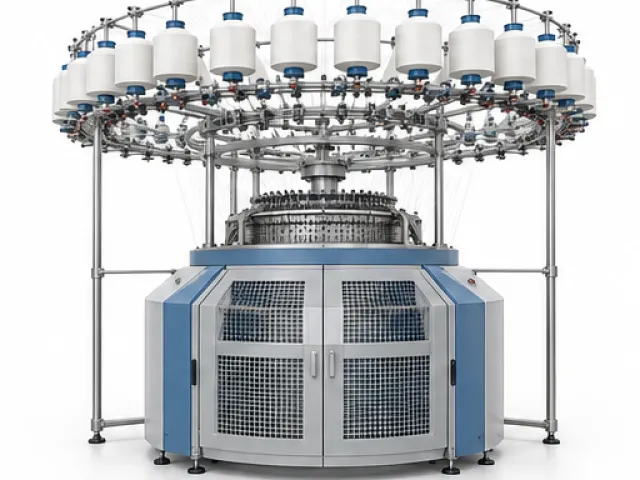
Equipment model · HAIRUN-2
The HAIRUN-2 is Hairun's integrated sock machine. After knitting, one transfer carries the sock through automatic stitch-to-stitch toe linking, turning and inspection, so it leaves the machine with the toe closed and the sock turned. The brochure adds fabric flattening, needle correction and yarn trimming. Its colour, speed and power figures sit in tables shared with other models, so ask for a sheet written for the HAIRUN-2. To get a price, send your yarn, sock sizes, pattern and a reference sock.
Manufacturer: Hairun Precision Machinery
- Cycle
- Knitting, toe linking, turning and inspection
- Transfer
- Single transfer from knitting into linking
- Toe linking
- Automatic, stitch to stitch
- Other features
- Fabric flattening, needle correction, yarn trimming
- Colours, Chinese text
- One main plus five auxiliary, 13 per sock
- Colours, English text
- Six feeders, up to 15 colours
- Pattern software named
- Design software for Windows 98/2000/XP
Published specifications
Values below come from the maintained catalogue record. The guide review date does not renew an earlier specification: read the dated source notes and confirm a current, matched configuration before comparing products.
Swipe the table sideways to see every column.
| Parameter | Published value |
|---|---|
| Process sequence | Knitting, toe linking, turning and inspection |
| Toe closure | Automatic stitch-to-stitch linking |
| Transfer arrangement | Single transfer |
How the HAIRUN-2 cycle runs
Hairun builds the HAIRUN-2 around a sequence that most sock plants split across several machines and workers. Plan the demonstration along the same sequence, with your own yarn on the cylinder and needle setup you intend to buy. [1]
Knitting
The sock is knitted to your size, structure and program. Check that the plain, terry or other construction you need belongs to the offered version.
Transfer and toe linking
The sock moves once into linking, where the toe is joined stitch to stitch. Examine seam alignment, closure and the properties your product needs.
Turning and discharge
The machine turns the sock and releases it. Watch several sizes, and see what happens to a piece that is incomplete or rejected.
Inspection
Get a list of the conditions the delivered machine detects or stops for. Anything outside that list stays with your quality staff.
Where the HAIRUN-2 brochure figures come from
- Get a single HAIRUN-2 sheet first, then compare the configurations of other sock knitting machines against it.
The technical sheet in the gallery follows the HAIRUN-2 cover, yet it mixes in other model names and some entries disagree with each other. The table sets out each issue and the figure to request for your machine. [1] [2]
Swipe the table sideways to see every column.
| Item | What the brochure shows | What to request |
|---|---|---|
| Model | HAIRUN-2 cover; the table names HR-01(6F) plain and HR-02P(7F) pile/terry; one small table is unnamed | The model and revision on your quote, and which table applies to it. |
| Cylinder and needles | HR-01, HR-02P and the small table each give their own cylinder and needle ranges | The HAIRUN-2 cylinder and needle options for your sizes and construction. |
| Colours and feeders | Chinese: one main plus five auxiliary colours, 13 per sock. English: six feeders, up to 15 colours | Feeders, yarn fingers and colour limits per course and per pattern, shown on your design. |
| Speed and output | Speed ranges tied to different models, and an English daily-output example with its own conditions | The HAIRUN-2 speed range and a counted full-cycle run with size, needle count, pattern and quality stated. |
| Electrical | Voltage and power differ between narrative and tables; two kW rows carry a machine-speed label; a process sheet gives whole-machine comparison figures | One electrical and utility schedule listing each load and what it covers. |
| Software | Design software for Windows 98/2000/XP, plus program and display features | The controller and software shipped today, file transfer, licences and the operating systems they run on. |
Toe seam, faults and needle correction
The toe seam is the main reason to buy an integrated machine, so set its pass marks before the visit. Pick reference socks and agree checks for alignment, closure, appearance and any functional test your customers ask for. Hairun compares its linking with hand linking; seam checks on your own yarn carry more weight.
Ask Hairun to stage an interruption in linking, transfer, yarn feed or turning, following the operating manual. Note the operator's steps, what becomes of the affected sock and how long the machine takes to return to good socks.
The brochure mentions a needle correction mechanism and a trimming arrangement. Ask how each one works, what it cannot handle and what maintenance it needs. Keep routine needle inspection and replacement in your plan either way. [1]
A counted acceptance run
Write the run below into the purchase contract so the factory trial and the check at your plant follow the same rules. [1] [2]
Set the matrix
List the yarns, sizes, constructions and patterns to run, with the model, revision, cylinder, needle count, program and settings for each.
Approve one finished sock
Run the full cycle and judge toe, dimensions and appearance against the reference. Label and keep the approved samples.
Count accepted output
Over a fixed period, count good socks or pairs and say which unit you use. Log rejects, part-finished cycles, stops and operator work.
Change over once
Move to another agreed yarn, design or size. Record hardware and software changes and the time back to approved quality.
Repeat on delivery
At commissioning, run the same matrix on the delivered machine with the samples and recovery procedures attached, and agree how deviations are settled.
Utilities, savings figures and what the order covers
Hairun's process sheets compare transfer time and electricity use with other methods and describe turning shared across a group of machines. Use those figures as a starting point. If you want seconds per pair or an energy figure in the contract, define the measurement on your machine and pattern.
Ask for electrical loads, compressed-air demand, any shared auxiliary units, a full installation and access drawing, and the boundary for any energy result Hairun promises. Tie any output or energy guarantee to one material, pattern, quality standard and set of run conditions.
List the labour and machines your product still needs after the cycle, such as boarding or other finishing, final quality checks, pairing and packing. The quotation should name tools, wear parts, maintenance, program preparation, training, warranty and service response. [1] [2]
Prepare a useful enquiry
Check the information you have ready. Your selections stay on this device as a draft; nothing is sent to a manufacturer.
0 of 8 items ready
Open enquiry workspace →Checklist and notes are not uploaded or saved after reload. Copy or download a draft to keep it. Opening the workspace does not send this draft.
Sources & limitations
Have Hairun put the following in writing before you order: the HAIRUN-2 revision, its cylinder and needle options, the feeder and colour limits for your design, the speed range and the counted output from your trial, the electrical and air loads, the software version supplied, and the finishing equipment left out of the order.
HAIRUN-2 integrated sock-machine brochure, cover and process sheets
Zhejiang Hairun Precision Machinery · Undated brochure; current official product-gallery images reviewed 11 October 2026
Cover and process pages for the HAIRUN-2. They show the one-transfer cycle, toe linking, flattening, needle correction and trimming, and Hairun's time and energy comparisons.
Brochure technical-feature and parameter sheet
Zhejiang Hairun Precision Machinery · Undated; original image reviewed 11 October 2026
The parameter sheet with HR-01 and HR-02P tables, colour counts in Chinese and English, and the speed, output, electrical and software entries.
Each source above lists its publisher and the date it was checked. Editorial method · Report an outdated detail