
AirMax · Glove knitting
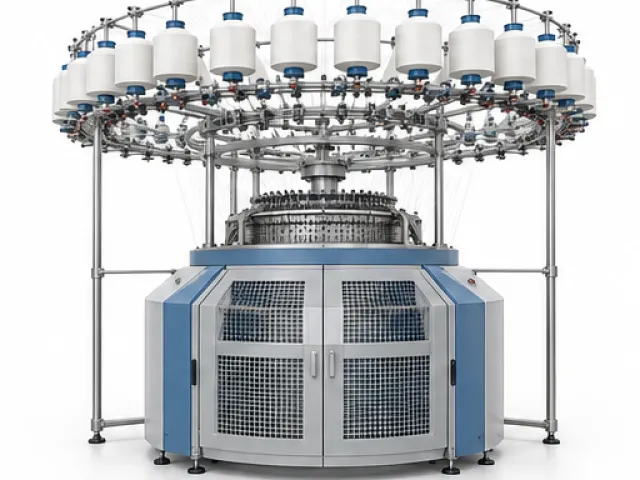
Equipment model · AirMax
The AirMax is a multifunction jacquard machine for patterned and shaped gloves. It is offered in 7G, 10G and 13G and knits with a single carriage and a single system. Eight yarn carriers park and change position by themselves, and the carriage travels at up to 1.6 m/s. The sheet also lists belt drive with AC servo control, a motor-controlled tight-tuck cam and automatic stops for yarn and program faults. Send your pattern file, colour map and yarn when you ask for a quote.
Manufacturer: Qiangsheng Precision Machinery
- Gauges
- 7G, 10G, 13G
- Knitting system
- Single carriage, single system
- Yarn carriers
- Eight, self-running; yarn storage device optional
- Needle selection
- Six-section electronic needle actuator
- Control
- Dahao, LCD touchscreen
- Carriage speed
- Up to 1.6 m/s
- Electrical (lower table)
- 220 V, 260 W
Published specifications
Values below come from the maintained catalogue record. The guide review date does not renew an earlier specification: read the dated source notes and confirm a current, matched configuration before comparing products.
Swipe the table sideways to see every column.
| Parameter | Published value |
|---|---|
| Gauge alternatives | 7G, 10G or 13G |
| Yarn carriers | 8 |
| Maximum carriage speed | 1.6 m/s |
| Drive | AC servo with belt transmission |
How the eight carriers handle colour
Each AirMax carrier runs by itself. The controller decides where every carrier knits and where it parks so the carriers keep clear of each other, and more than one carrier can feed in a single row. That is how Qiangsheng reaches the more complex colourwork it advertises.
To find out whether your design fits, send the colour allocation per carrier together with the pattern file or artwork. Mark the places where colour changes meet shaping, typically at the finger crotches and around the cuff. A demonstration on the offered machine and software, with those changes knitted, answers the question faster than a brochure.
Basic and multicolour structures sit beside tuck, needle selection, jacquard and shaping in the function list. Look over a first piece for floats, stitch formation and shape. Socks, scarves and garment accessories are mentioned too, and each one would need its own sample and a look at the working range. [1]
The AirMax sheet, line by line
The upper table on the sheet covers motion and control. The lower one mixes size, power, speed and averages under thin labels. Read the two apart and ask which numbers the supplier will write into the contract. The note on knitting gauge for gloves explains how the three gauges trade fineness against yarn size, and when offers from several builders arrive, compare configurations item by item. [1]
Swipe the table sideways to see every column.
| Item | On the sheet | What to settle |
|---|---|---|
| Gauge | 7G, 10G, 13G | Choose from your yarn and glove; ask whether one machine can switch gauge. |
| Carriage and system | Single carriage; the introduction says single system | Get the needle-bed working width for your program. |
| Carriage speed | Up to 1.6 m/s | This is carriage travel; glove output comes from your own run. |
| Needle selection and tuck | Six-section electronic needle actuator; motor-controlled tight-tuck cam | Knit your selection and tuck settings on the sample. |
| Drive | Belt drive with AC servo control | Ask for belt and drive part numbers and service intervals. |
| Yarn feed | Yarn feeder; yarn storage device optional | List the feed package in the quote and knit your own yarn. |
| Electrical | 220 V and 260 W on the 7G, 10G and 13G rows | Confirm frequency, rated input and auxiliaries; meter energy per pair yourself. |
| Size and dimensions | M; 1100 × 900 × 1350 | Units and size coverage are missing; request an installation drawing. |
| Other lower-table figures | 300r; averages of 250, 230 and 190; electricity columns | No time base or units are given; ask for a corrected sheet. |
From your design to the Dahao screen
The Dahao controller has an LCD touch display with a graphical interface that stores pattern files. Patterns load through a USB port, a connected PC or an Internet link, and the menus switch between Chinese, English, Russian and other languages. The sheet names neither the file format nor the software edition.
Ask the supplier to take your design all the way through: editing, gauge and size settings, carrier assignment, transfer, preview and backup. Write down the firmware and design-software versions at delivery so a later pattern change can be repeated on the same footing.
Upgrades to the software and pattern system are described as free. Find out how long that lasts, which versions qualify, whether upgrades work offline and what licence or hardware costs apply. Linking the machine to your production-management system is a separate question to raise. [1]
Auto-stops, guards and restarts
The AirMax halts itself on yarn breakage, knots, overload, program errors and other faults. A protective cover with a stop sensor, an emergency stop and a power-off device are fitted.
Ask the technician to show each safeguard working and the approved restart, following the manual. Note how the operator finds the cause, clears it and deals with the half-knitted piece. Keep every guard in place during the run, even if that slows it down.
With dense colourwork, check that the needles and carriers pick up in the right state after a restart, and inspect the knitting just past the stop. Count any piece that needs rework or goes to scrap when you work out output. [1]
Running an AirMax sample
Plan the run on your own glove and pattern. A trial run on your own material, measured against limits agreed beforehand, gives a sound base for factory acceptance. Check your electrical supply against the installed power on the quote before the machine is switched on. [1]
Set the inputs
Fix the gauge, yarn count and material, colour map, glove dimensions and file revision, and note any optional tension or storage device.
Knit the hard parts
Run fingers, cuff, shaping and colour changes, then check floats, holes, tight or loose areas and placement against your approved glove.
Compare several pieces
Weigh and measure consecutive gloves by an agreed method, and set tolerances before anyone signs.
Break a yarn on purpose
Use the safe procedure from the manual, restart, inspect the resumed knitting and count any reject.
Time a set run
Log start and end, settings, stops, operator time and good and bad gloves, and say whether finishing is included.
Meter the power
Fix the meter boundary and duration, include auxiliaries, and divide by accepted gloves once both figures are in.
The 25% claim and the lower-table averages
The small carriage and fast reversal are said to lift efficiency by roughly 25% compared with earlier models, with the note that results depend on fabric width. The sheet gives no baseline machine, matching program or outside trial.
The averages of 250, 230 and 190 and the electricity columns lack units and time periods, so they cannot be read as daily pairs or kWh per pair. Request a corrected sheet and a run on your own design.
Edging, dotting and packing happen on other machines that the maker lists separately; add their handling time to your costing, and weigh the AirMax against other glove knitting machines if plain gloves are most of your work. A knitted AirMax glove still needs testing as a finished product before it is sold with any protective claim. Put spare needles, wear parts, training and warranty into the offer as well. [1]
Prepare a useful enquiry
Check the information you have ready. Your selections stay on this device as a draft; nothing is sent to a manufacturer.
0 of 8 items ready
Open enquiry workspace →Checklist and notes are not uploaded or saved after reload. Copy or download a draft to keep it. Opening the workspace does not send this draft.
Sources & limitations
Qiangsheng should sign off these AirMax points before you pay a deposit: the gauge you will receive, the needle-bed working range, the yarn-feed parts and storage device in the price, the pattern file format with its software licence and upgrade terms, the units behind 300r and the lower-table averages and electricity columns, an installation drawing with dimension units, and the spares and training supplied. Prove output and energy on your own glove, and test the finished glove for any protective rating.
AirMax 7G / 10G / 13G multifunction jacquard knitting machine
Shaoxing Qiangsheng Precision Machinery Manufacturing · Undated; accessed 11 October 2026
The AirMax product page with its knitting functions, carrier system, Dahao controller, stop devices and the upper and lower technical tables.
Each source above lists its publisher and the date it was checked. Editorial method · Report an outdated detail