
Air-jet loom profile reeds
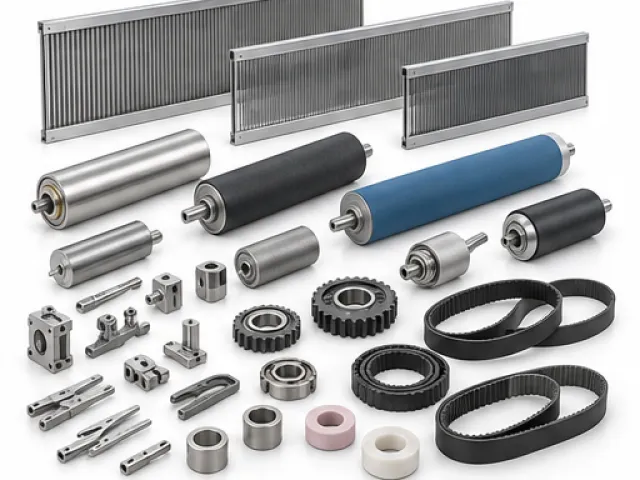
Equipment series · Air-jet loom profile reeds
Dingfeng's air-jet profile reeds are a family of loom-specific reeds rather than one universal part. Catalogue sheet 06 covers Picanol, Tsudakoma, Toyota, Sulzer/Somet and Dornier air-jet looms, each with its own reed, plus a separate double-air-channel terry reed. Sheet 07 gives a basic-dimension table: Tsudakoma rows list overall heights of 111.5, 116.5 and 120 mm with a 5.5 mm channel width, Toyota rows 116.5 and 120 mm with 5.5 mm, and Picanol rows 110 and 119 mm with 5.5 or 6 mm. To get a quote, send your loom model, the marking or drawing of the reed you run now, the dent requirement with its unit and the quantity per variant.
Manufacturer: Zhejiang Dingfeng Textile Equipment Co., Ltd.
- Product
- Profile reeds for air-jet looms, sold as loom-specific variants
- Loom families in the catalogue
- Picanol, Tsudakoma, Toyota, Sulzer/Somet, Dornier
- Terry option
- Double-air-channel terry reed
- Overall height h1 (examples)
- 110 to 120 mm across the Picanol, Toyota and Tsudakoma rows
- Channel width k (examples)
- 5.5 mm; Picanol rows also 6 mm
- Ordered against
- A confirmed dimensioned drawing or an approved sample
Published specifications
Values below come from the maintained catalogue record. The guide review date does not renew an earlier specification: read the dated source notes and confirm a current, matched configuration before comparing products.
Swipe the table sideways to see every column.
| Parameter | Published value |
|---|---|
| Component type | Profile reed |
| Application | Air-jet weaving |
| Compatibility scope | Loom-specific variants; exact model confirmation required |
Which loom each reed version is drawn for
- Five loom families named on sheet 06
- A separate double-air-channel version for terry weaving
- Profile shape follows the loom's weft-insertion design
Sheet 06 of the catalogue names five air-jet loom families: Picanol, Tsudakoma, Toyota, Sulzer/Somet and Dornier. Each name marks the loom the profile was shaped for. Read them as Dingfeng's own fitting references and ask which loom models and builds each version covers.
The same sheet adds a double-air-channel terry reed. If you weave terry, say so at the start, because a standard version for flat fabrics is a different part.
Dingfeng's note on reed use explains that the profile shape follows the loom's weft-insertion design, and it advises against swapping reeds between different air-jet looms. A reed that sits well on one machine can disturb the air path on another, so the loom model is the first thing to settle. [1] [3]
Reading the sheet 07 dimension table
Sheet 07 shows profile cross-sections, a side view and a table of basic dimensions. The drawing labels overall height h1, channel height h2, channel width k and further profile measures. Many rows carry more than one value, which means one loom family can take several reed variants.
The rows below show a few of the published h1 and k values. They help you see which variant questions to ask. The sheet carries no date and does not tie every combination to a named loom model or revision, so the full drawing for your order comes from Dingfeng. [2]
Swipe the table sideways to see every column.
| Loom family row | Values on the sheet | Question for Dingfeng |
|---|---|---|
| Tsudakoma | h1: 111.5 / 116.5 / 120 mm; k: 5.5 mm | Which height, and which remaining profile dimensions, match the loom you run? |
| Toyota | h1: 116.5 / 120 mm; k: 5.5 mm | Which exact variant and full dimension set apply? A shared channel width with another row does not make the reeds swappable. |
| Picanol | h1: 110 / 119 mm; k: 5.5 / 6 mm | Which height goes with which channel width, together with the other drawing dimensions? |
What a reed enquiry should contain
Preparing the request
A good reed enquiry covers the loom and the cloth. Give the loom make, the full model and build, the marking on the reed you use now, and whether you want a like-for-like replacement or a reed for a new fabric. Attach an authorised drawing, or agree with Dingfeng how a reference sample will be measured. Photos help with orientation, but dent spacing, channel geometry and mounting tolerances have to be measured.
State the dent requirement together with its counting length or unit. A bare number can be read on two different bases, and the mistake only shows when the reed reaches the loom. Add the working width, the yarn and fabric details that matter for the job, and how many reeds of each variant you need.
Ask Dingfeng to mark the accepted dimensions and any deviations on the drawing it returns, and to list the points that still depend on a sample. Material, finish or an inspection certificate for the delivered reeds should be written into the request, since the family sheet does not cover them. [2] [3]
Checking reeds on arrival and on the loom
Dingfeng's use note names the points to inspect: dent evenness and condition, reed structure, alignment, air-channel dimensions and, where the equipment exists, airflow. It leaves the pass limits to each installation. Set those limits with Dingfeng before the order, then run the acceptance check in the four stages below. [3]
Measure the delivered reed
Match the reed marking and drawing revision to the order. Measure the agreed critical dimensions, look for bent or damaged dents, and compare against the drawing tolerances.
Confirm the fit
Have a qualified loom technician mount the reed following the instructions for your loom and reed. Passing the measurements is the first gate; the fit on your own weft-insertion setup is the second.
Weave with it
If you need a weaving trial, fix the loom setup, yarn, fabric and running conditions in advance. Record the agreed fabric and running results and any faults. A short idle run is no substitute for production conditions.
Lock the reference for reorders
File the accepted drawing, the reed marking and the trial record. Ask Dingfeng to seek your approval before any later change or substitute, so each reorder points to the reed you tested.
Packing, storage and installation
Heavy loads, stacking and any knock to the air channels can bend reed dents, Dingfeng warns. Ask for packing that shields that zone, and keep the variant marking on each reed through storage. A reed made exactly to the drawing can still be rejected if it arrives with bent dents.
The use article also gives installation and workshop settings. Those suit Dingfeng's general case. For setting up your own machine, follow the manual for your loom and the approved reed. [3]
Comparing reed quotations
To compare quotations fairly, line up the same items in each: drawing revision, dent requirement with unit, quantity per variant, material and finish, inspection record and packing. List any sample approval or trial support separately. A lower unit price only means something when the technical scope matches.
The catalogue gives no price, lead time, minimum order or warranty term, and makes no figure-based claim about airflow or fewer fabric defects. Ask Dingfeng to quote the commercial terms for your order. If a supplier offers an improvement percentage, ask for the original reed, the loom conditions and the measuring method behind it. [1] [2] [3]
Prepare a useful enquiry
Check the information you have ready. Your selections stay on this device as a draft; nothing is sent to a manufacturer.
0 of 8 items ready
Open enquiry workspace →Checklist and notes are not uploaded or saved after reload. Copy or download a draft to keep it. Opening the workspace does not send this draft.
Buyer questions
Sources & limitations
This page is based on Dingfeng's reed product page, catalogue sheets 06 and 07 and its note on reed use. Nobody from the site has measured a reed, tested airflow or run one on a loom. Before ordering, ask Dingfeng to confirm in writing: the variant that fits your exact loom model, one complete drawing with tolerances and the dent unit, the inspection limits and record for the shipment, packing for the air-channel area, and price, lead time, minimum order and warranty terms.
Air-jet profile reed product page and illustrated sheet 06
Zhejiang Dingfeng Textile Equipment · Undated; accessed 11 October 2026
Reed versions named by loom family and the separate double-air-channel terry reed. The loom names are Dingfeng's fitting references.
Profile reed dimensions: illustrated catalogue sheet 07
Zhejiang Dingfeng Textile Equipment · Undated; accessed 11 October 2026
Profile cross-sections, a side view and the basic-dimension table with h1, h2 and k values by loom family.
Precautions for use of air-jet reeds
Zhejiang Dingfeng Textile Equipment · 23 November 2023, as listed by the manufacturer
Why reeds should stay with their loom, the points to inspect, handling risks, plus installation settings for the general case.
Each source above lists its publisher and the date it was checked. Editorial method · Report an outdated detail