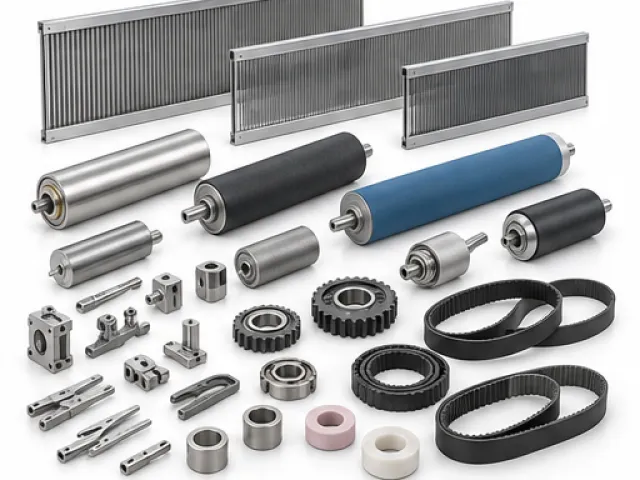
Zhejiang Dingfeng Textile Equipment makes loom components in Anchang, Keqiao, Shaoxing, and sells them under the Yuequan brand. The range covers reeds (air-jet profile, water-jet, industrial-loom and flat), aluminium-alloy heald frames and their accessories, flat steel healds, drop wires, warp beams and cloth rollers. Its air-jet reed catalogue has separate versions for Picanol, Tsudakoma, Toyota, Sulzer/Somet and Dornier looms, plus a double-air-channel terry reed. To get a usable quote, send Dingfeng the part type, your full loom model and the drawing or sample of the part you are replacing.
Dingfeng's company introduction and product menu group its loom parts and accessories into four families. Each family fits the loom in a different way, so write a separate line for each part in your weaving enquiry. Buying reeds and frames from the same catalogue makes shipping simpler, but each part still has to match your own loom.
The right-hand column in the table lists what Dingfeng needs from you to quote each family. Stock levels vary by variant, so ask which items are ready and which are made to order. [1][2][4][5]
Swipe the table sideways to see every column.
Product range and what to name in a quote request
Product family
What the catalogue offers
What to send with your request
Reeds
Air-jet profile reeds, water-jet reeds, industrial-loom reeds and flat reeds
Loom model, reed type, working dimensions, dent requirement with its unit, and the reference drawing.
Heald frames and accessories
Complete aluminium-alloy frames, plus accessories sold as separate items
Say whether you need a complete frame or replacement parts, and identify the existing frame and its mating hardware.
Flat steel healds and drop wires
Two separate product groups with their own catalogue pages
Part drawing or approved sample, material requirement, and the loom and stop-motion arrangement they serve.
Beams and cloth rollers
Warp and weaving beams, and cloth rollers
The part's job on the loom and its machine-side connections, described in full rather than by a translated general name.
02
Air-jet profile reeds: match the loom model, then the drawing
Versions listed for Picanol, Tsudakoma, Toyota, Sulzer/Somet and Dornier looms
Separate double-air-channel terry reed
Dimension table with some alternative values, such as 5.5/6 mm channel widths
Dingfeng's illustrated catalogue shows air-jet profile reeds in versions for Picanol, Tsudakoma, Toyota, Sulzer/Somet and Dornier looms, and a double-air-channel terry reed. The brand names tell you which loom family each version was drawn for. They are catalogue references. Ask Dingfeng which exact loom models and configurations each version fits.
The next catalogue sheet gives cross-sections and a basic-dimension table organised by loom family. Some rows offer alternatives. Some channel-width entries read 5.5/6 mm. Pick one value per dimension with Dingfeng for your loom, and have it written onto the drawing you approve.
Dingfeng's own article on reed use warns against moving profile reeds between different air-jet looms, because the reed shape is tied to each loom's weft-insertion system. Give the full loom model and the marking or drawing of your current reed, and ask for a dimensioned proposal back before you order. [2][3]
03
Inspection points Dingfeng lists for air-jet reeds
Planning incoming inspection for reeds
The reed-use article lists what to check on an air-jet reed: reed number, structure, rigidity, dent elasticity, even dent spacing, surface condition, alignment to the baulk, and air-channel height and depth. Where facilities allow, it also suggests checking airflow. These points give you a ready outline for an inspection plan.
Turn that outline into numbers with Dingfeng. Decide which drawing dimensions and properties will be measured, the limits for each, the sample size and the record that ships with the order. If airflow matters on your loom, set the test conditions and the pass method together with Dingfeng and your loom technician. A record that names each measurement and its result tells you far more than a general mark saying the reed was tested.
The article also gives installation torque, room conditions and tool sizes. Treat those as Dingfeng's general advice. For installation and adjustment, follow the instructions for your own loom, reed and configuration. [3]
04
Company background
Dingfeng's timeline traces the company back to 1986 and says it took the name Zhejiang Dingfeng Textile Equipment in 2014. The same timeline records an aluminium business set up in 2005. When you weigh the supplier, look at the textile-component business itself; figures for the wider group or its aluminium side describe a different operation.
The ITMA ASIA + CITME 2024 exhibitor directory lists the company under its English and Chinese legal names, at the Jiuding Village, Anchang address, with its official domain and booth H3-F45. That gives you a public company record to match against the quotation and contract.
The company introduction mentions ISO management-system standards and Zhejiang Manufacturing certification for some products. If your purchasing process needs these, request current certificates that name the supplying company and the product you are buying, with their validity dates. [1][6]
05
From approved drawing to repeat order
Replacement parts reorder smoothly when every shipment refers back to one confirmed drawing revision. These four steps link a good first sample to later orders.
Describe the current installation
Note the loom make, model and configuration, the marking on the current part and the problem you want solved. Say whether you want an exact replacement or a change for a new fabric or running condition.
Agree one proposed drawing
Ask Dingfeng to name the variant it offers, its dimensions, the material or finish, and any point that still depends on a sample. For a reed, write the dent-count unit on the drawing.
Approve the sample before the quantity
Agree incoming inspection and, where useful, a fit check or running trial on your loom. Keep the approved drawing, the sample marking and the results on file. A part that looks the same still needs measuring.
Keep repeat supply traceable
Put the approved drawing revision, quantity, inspection record and packing requirements on each order. Ask Dingfeng how it will tell you about any substitute or design change before it reaches a later shipment.
06
Packing and receiving reeds
Dingfeng's handling notes warn that loading, stacking or touching the air-channel area can damage reed dents. Agree packing that protects that area, and check reeds on arrival against the approved drawing.
Ask for the variant marking on both the package and the documents, so similar-looking reeds can be told apart at goods-in. For an accessory order, list the hardware included and any items you will reuse from the current installation. Lead time, minimum order, spare parts kits and on-site service are not stated in the catalogue, so ask Dingfeng to quote them for your order. [3]
Equipment & specifications
Published model or series information. Open the equipment record for its full scope and configuration notes.
Generic parts & accessories machinery illustration · not the listed equipment
Profile reeds for air-jet looms from Dingfeng (Yuequan), drawn to suit Picanol, Tsudakoma, Toyota, Sulzer/Somet and Dornier machines, plus a double-air-channel terry reed. Published overall heights run from 110 to 120 mm, with channel widths of 5.5 mm and, on Picanol rows, 6 mm. Each reed is ordered against a confirmed drawing. Send the loom model, the current reed's marking or drawing, the dent requirement with its unit and quantities.
Swipe the table sideways to see every column.
Air-jet loom profile reeds catalogue values
Parameter
Published value
Component type
Profile reed
Application
Air-jet weaving
Compatibility scope
Loom-specific variants; exact model confirmation required
Checklist and notes are not uploaded or saved after reload. Copy or download a draft to keep it. Opening the workspace does not send this draft.
Sources & review
This page draws on Dingfeng's company and product pages, its air-jet reed catalogue sheets and the ITMA ASIA + CITME exhibitor directory. Nobody from the site has visited the factory, measured a part, run a loom trial or checked certificates. Before ordering, ask Dingfeng to confirm in writing: the reed or part variant that fits your exact loom model, the full drawing with one value for each dimension, the inspection limits and record for your order, packing for the air-channel area, current certificates for the supplying company and product, and lead time, minimum order and spare parts terms.
The product range, the Yuequan brand and the company milestones for 1986, 2005 and 2014, with the capacity and certification figures Dingfeng publishes.
Publication: Not dated; accessed 11 October 2026 · Reviewed: 2026-10-11
Air-jet profile reed catalogue and illustrated sheets 06–07