
DX231A Type I · Yarn doubling
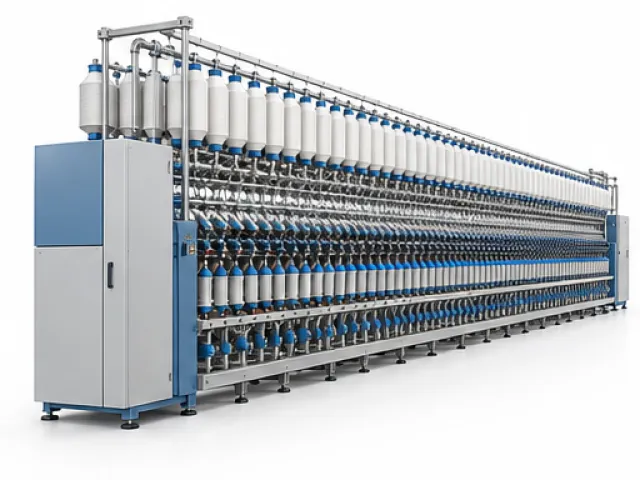
Equipment model · DX231A Type I
The DX231A Type I is an electronic precision doubling machine with manual operation. It winds the feed package for a twister, and its maker offers it as the preparation stage for the short-staple G series. The Type I table gives short-staple yarn from 10 to 80 Ne, a package of up to 4 kg on a tube the customer specifies, spindles at a 450 mm pitch in sections of 4, up to 12 sections and 40 positions as the standard build. For a quote, send the yarn, the number of ends, your tube and the twister that will take the packages.
Manufacturer: Dongxing Textile Machinery
- Version
- Type I, manual operation
- Yarn count
- Short staple, 10–80 Ne
- Package
- Up to 4 kg on a customer-specified tube
- Spindle layout
- 450 mm pitch; 4 per section; up to 12 sections
- Standard positions
- 40
- Winding speed line
- ≤800 r/min as printed
- Listed dimensions
- 2,380 × 860 × 1,300 mm (L × W × H)
Published specifications
Values below come from the maintained catalogue record. The guide review date does not renew an earlier specification: read the dated source notes and confirm a current, matched configuration before comparing products.
Swipe the table sideways to see every column.
| Parameter | Published value |
|---|---|
| Spindles per section | 4 |
| Spindle pitch | 450 mm |
| Maximum sections | 12 |
| Yarn count | 10–80 Ne |
| Maximum package mass | 4 kg |
Type I table, line by line
Every value below is printed in Dongxing's Type I table. The material line there is broad, so plan from the short-staple count entry and confirm your own fibre or blend.
The count is given in Ne. If your mill works in tex or Nm, convert it with the count system written next to every figure, and state whether the yarn is single or plied. [1]
Swipe the table sideways to see every column.
| Item | Printed value | Question for the quote |
|---|---|---|
| Yarn count | Short staple 10–80 Ne | Which fibre or blend, how many ends, and whether your exact yarn sits inside the range. |
| Spindle layout | 450 mm pitch; 4 per section; up to 12 sections; 40 standard positions | How many sections and positions the offer covers. Twelve sections is the ceiling, while forty positions is the standard build. |
| Operation | Manual | How doffing and package handling are done, and what the operator does at each position. |
| Tube and package | Customer-specified tube; package up to 4 kg | The tube drawing, package build and usable package weight your twister accepts. |
| Winding speed | ≤800 r/min as printed | Whether r/min is the intended unit. Ask for the speed in a form you can turn into output before sizing the line. |
| Dimensions | 2,380 × 860 × 1,300 mm, length × width × height | Which section count this outline belongs to; ask for a full-machine layout with access space. |
Agree the package before the winding programme
- Electronic control of package formation
- Yarn creel built into the machine
- Single-spindle length measurement as an option
Dongxing fits a yarn creel into the machine and controls package formation electronically. It also mentions a high-density winding programme. Single-spindle length measurement is listed as an option, so name it in the order if your process depends on equal lengths.
Tell the supplier which twister will take the packages and what feed package it needs. Then agree the tube, the package shape, weight and package build, along with the yarn, count and number of ends. Ask for samples that you can run on that twister, since a neat package at the doubler is only half the test.
Density is promoted without a test method. Agree how it will be measured and tie the result to unwinding. A harder package that unwinds badly, splits ends or adds stops will cost output on the next machine.
Hold every quote to the same configuration: version, position count, programme and options. That lets you compare offers on equal terms. [1]
The energy figure belongs to the twister
The DX231A page promotes a cut in power use on downstream two-for-one twisting after precision doubling, measured at the same total package quantity. No full comparison or power schedule for the DX231A itself is published, so keep the percentage out of a payback sum until you have measured it.
Promotional cards on the same page mention fewer breaks, the drive system and use with another named machine. Ask for a signed feature list for the Type I version you are buying and check it against the table and option list.
For a fair test, hold yarn, package basis, twister settings and accepted output equal. Log total energy, running time, stops and handling work in one record, so a change in yarn or settings is never credited to the doubler. [1]
Follow the package into twisting
Agree the steps below with the supplier before the sample run, and keep the doubling and twisting results side by side. [1] [2]
Set the input and goal
Write down fibre, count, end count, feed packages, the tube and output package you want, and the receiving twister. Fix quality and output targets before touching settings.
Log the doubler setup
Note the Type I build, active positions, winding programme and options fitted, and record the real speed setting alongside a corrected speed statement.
Check package spread
Pick agreed positions and compare weight, shape, build and any length reading. Set tolerances and note how each value is measured.
Run the twister
Put the packages on the intended twister for an agreed time. Count end splits, breaks, stops and leftover yarn, and grade the accepted output.
Close the record
Where energy or output gains are part of the deal, use an equal-output baseline with a clear measuring boundary. Keep samples, settings and results for commissioning.
Layout, utilities and service for the positions you order
Ask for a full-machine drawing for your section and position count, showing the creel, room for loading and doffing, and service access. Plan floor space from that drawing, as the printed outline gives no position count. Request the electrical load and any other utilities for the build being delivered.
Dongxing offers installation guidance, engineering supervision or its own installation team. Write the chosen option into the quotation, with who covers labour, tools, utilities, training and commissioning, and list the controls, the length-counter option and the wear items for this version.
The doubler is one step of yarn preparation, so price, lead time and warranty only mean something against the full route. Attach the corrected parameter sheet, the package specification and the trial procedure to the order, so every offer describes the same machine. [1] [2]
Prepare a useful enquiry
Check the information you have ready. Your selections stay on this device as a draft; nothing is sent to a manufacturer.
0 of 8 items ready
Open enquiry workspace →Checklist and notes are not uploaded or saved after reload. Copy or download a draft to keep it. Opening the workspace does not send this draft.
Sources & limitations
Ask Dongxing to put these points in writing before you order: the meaning of the ≤800 r/min line, the layout for your section and position count, the features and options fitted to your Type I machine, the count range for your fibre, the electrical load, and the basis of any energy saving you plan to rely on. Price, lead time, warranty and output rate come from a current offer and your own linked package and twisting trial.
DX231A electronic precision doubling machine: Type I table and features
Zhejiang Dongxing Textile Machinery · Undated; accessed 11 October 2026
The Type I count range, spindle layout, manual operation, tube and package data, electronically formed packages and the length-counter option, plus the promotional energy claim.
Dongxing installation and technical services
Zhejiang Dongxing Textile Machinery · Undated; accessed 11 October 2026
The installation options Dongxing offers: guidance, engineering supervision or a team sent to site.
Each source above lists its publisher and the date it was checked. Editorial method · Report an outdated detail