
Top-drive four-roller compact spinning
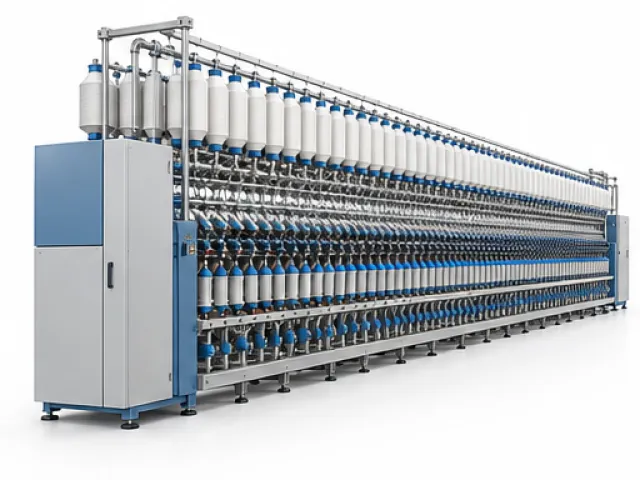
Equipment series · Top-drive four-roller compact spinning
The top-drive four-roller compact-spinning device is a conversion kit from Haoming that fits onto a ring-spinning frame already in the mill. The maker breaks it into five subsystems: the electrical section, negative pressure, auxiliary loading, the drafting transmission, and a combined drafting and condensing unit. Tension draft is adjusted by picking guide and drafting rollers of different diameters, and the intermediate transmission gears run in a sealed roller box. On the imported frames the maker refers to, the original front roller and roller stand do not have to come out. For a quote, send the frame model, its position count, drafting drawings and the yarns you plan to spin.
Manufacturer: Haoming Machinery Technology
- Type
- Compact-spinning conversion kit for an installed ring frame
- Subsystems
- Negative pressure, drafting transmission, drafting/condensing, auxiliary loading, electrical
- Draft adjustment
- Tension draft set through guide and drafting roller diameters
- Gear drive
- Intermediate gears enclosed in a sealed roller box
- Product page date
- 7 April 2017
Published specifications
Values below come from the maintained catalogue record. The guide review date does not renew an earlier specification: read the dated source notes and confirm a current, matched configuration before comparing products.
Swipe the table sideways to see every column.
| Parameter | Published value |
|---|---|
| Roller arrangement | Top-drive four-roller |
| Transmission housing | Sealed gearbox |
| Micro-draft adjustment | Roller diameter selection |
How the kit sits on an existing frame
Instead of a new machine, the mill gets a condensing zone, a suction supply and a drive added to the ring-spinning frame it already has. Haoming presents the top-drive layout as a way to leave the frame's own structure alone, and on the imported machine families it cites, the original front roller and its stand can stay where they are.
That saving only holds on a frame that matches those references. Model, build year, wear and past rebuilds all change what has to be swapped. Send the frame model and generation, the number of positions, the drafting layout, roller and stand geometry, drawings and a note of earlier modifications.
Ask Haoming to answer with a marked-up drawing that shows which parts stay, which are replaced, which are new, and which connections the mill itself must make. The product page dates from 7 April 2017, so ask too for the revision on offer today and its parts list. [1]
Pricing the five subsystems one by one
Two offers for the same kit can differ widely in what they actually deliver. Ask for a price against each of Haoming's five subsystems so you can see where a cheaper bid leaves work out. The note on how to compare machine configurations explains the same habit for whole machines. [1]
Swipe the table sideways to see every column.
| Subsystem | What the offer should name | Where offers often differ |
|---|---|---|
| Negative pressure | Fans and suction parts, ducting, filters, the pressure and flow needed, and cleaning access | One bid prices parts only while another includes a working suction installation and its power draw |
| Drafting transmission | Gears and roller-box parts, ratios, connection points, parts that stay, and lubrication needs | Keeping the front roller can still mean new transmission parts behind it |
| Drafting and condensing | Condensing parts, guide and drafting roller sizes, and the fibre and yarn they are chosen for | A single roller set offered as if it covered every yarn you spin |
| Auxiliary loading | Loading parts, how they match the frame, how they are adjusted and the agreed settings | Nobody named as responsible for matching new loading to the old arrangement |
| Electrical | Controls, loads, wiring, interlocks and the commissioning work | An offer silent on control changes, leaving the mill to discover them on site |
Setting tension draft with roller diameters
Haoming changes tension draft by fitting guide and drafting rollers of different diameters, choosing the combination to suit the yarn being spun. The page gives no numeric range and no recommended setting for any particular yarn count.
Ask which roller combinations are available now, which yarns each one is meant for, how the right one is worked out, and what physically has to be swapped to move between them. Write the chosen combination into the trial record. A good sample is only useful if the same setup can be put back later. [1]
Servicing the sealed roller box
The intermediate transmission gears run inside a sealed roller box. A closed housing keeps fly and dust out, but the gears inside still wear. Ask how the box is opened, what lubricant it takes and how often, which wear parts are stocked, and how long a box swap takes on a running frame. [1]
Testing yarn from converted positions
Haoming's device page gives no before-and-after yarn data. A mill can produce its own by converting a group of positions and spinning them against unconverted ones from the same roving. [1]
Take a baseline
Log frame condition, the fibre mix and roving batch, the yarn count and system, draft and twist, spindle speed, yarn quality and end breaks before any change.
Write down the conversion
List every part that stayed or changed, the roller combination, suction readings, loading and control settings, and the alignment checks done at fitting.
Agree tests and sampling
Pick the hairiness, strength and evenness tests that matter for your product, and sample across many positions, not a favoured few.
Spin under matched conditions
Keep material and room conditions the same, or note every difference. Count accepted yarn, breaks, stops and operator interventions over a fixed run.
Meter the power
If energy is part of acceptance, measure drive power plus the added suction load, and state how idle time and warm-up are treated.
File the recipe
Hand over accepted samples, settings, test methods and cleaning instructions together, and agree who answers for later drift.
Planning the shutdown and restart
Before signing, agree the order of work on the frame, which original parts stay, what access the fitters need, and who removes old parts, fits new ones and makes the electrical and suction connections. Get a list of what the mill must have ready before the team arrives.
Ask for the commissioning steps, the checks at each stage, help with the first trial run, operator training and a schedule of spares and consumables. Agree how the frame returns to accepted production and what happens if a fit problem turns up halfway.
Haoming's report of 17 August 2026 covers a separate ZR71 job of about 30,000 positions, fitted and commissioned in roughly one month. Ask whether that job used this exact kit, and plan your own downtime from your frame count and site. [1] [2]
Numbers to get in the quotation
The device page publishes no yarn-count range, position limit, suction pressure or flow, motor load or quality gain. Ask for each of these for your frame, fibre and the configuration being offered.
No price, energy saving or payback figure is given either. A fair cost comparison adds up the full subsystem supply, the production lost during fitting, trial support, running costs for consumables and maintenance, and the yarn result accepted at handover. [1]
Prepare a useful enquiry
Check the information you have ready. Your selections stay on this device as a draft; nothing is sent to a manufacturer.
0 of 8 items ready
Open enquiry workspace →Checklist and notes are not uploaded or saved after reload. Copy or download a draft to keep it. Opening the workspace does not send this draft.
Sources & limitations
The device details here come from Haoming's product page and its ZR71 project report. Before ordering, get these points from Haoming in writing: whether the kit suits your exact frame and build generation, a parts list for each subsystem, the roller combinations and draft settings for your yarns, the suction and electrical loads, the downtime for your position count, the yarn-quality figures for acceptance, and the roller-box maintenance and spares terms.
Top-drive four-roller compact-spinning device
Zhejiang Haoming Machinery Technology · Page dated 7 April 2017; accessed 11 October 2026; current displayed machine image inspected
Lists the kit's five parts, explains which imported frames keep their front roller and stand, and describes draft adjustment by roller size and the enclosed gears.
Completion report: ZR71 compact-spinning conversion at Xianfang No. 1 mill
Zhejiang Haoming Machinery Technology · 17 August 2026; accessed 11 October 2026
Haoming's own report on converting ZR71 frames at one mill, giving the position total and the time it took to fit and commission.
Each source above lists its publisher and the date it was checked. Editorial method · Report an outdated detail