
LL321G · Two-for-one twisting
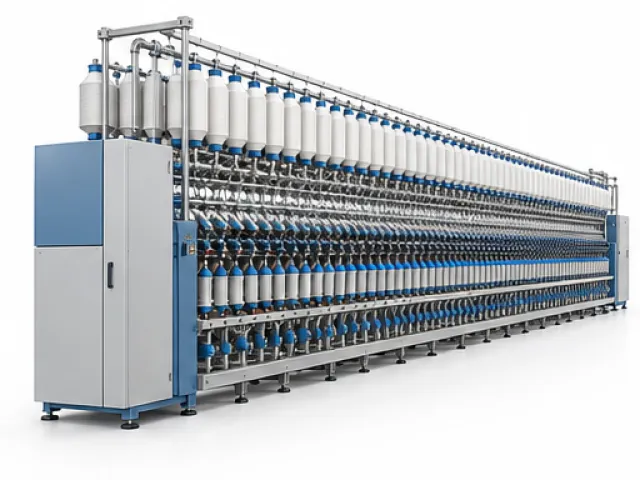
Equipment model · LL321G
The LL321G is a short-staple two-for-one twister from Xinchang Lilai, made for plied cotton, flax, wool and blended yarn. Frames are assembled section by section, 16 spindles each, to a maximum of 208 spindles over 13 sections, at 225 mm pitch. The sheet lists spindle speed up to 12,000 rpm, delivery up to 100 m/min, S or Z twist and a take-up package up to 250 mm in diameter on a 170–175 mm tube. Each frame has yarn-break alarms and length counting. For a quote, send a plied sample, the twist you need, your package drawings and the section count.
Manufacturer: Xinchang Lilai Textile Machinery Co., Ltd.
- Layout
- 16 spindles per section
- Maximum build
- 13 sections / 208 spindles
- Spindle pitch
- 225 mm
- Spindle speed
- Up to 12,000 rpm
- Delivery
- Up to 100 m/min
- Package diameter
- Up to 250 mm
Published specifications
Values below come from the maintained catalogue record. The guide review date does not renew an earlier specification: read the dated source notes and confirm a current, matched configuration before comparing products.
Swipe the table sideways to see every column.
| Parameter | Published value |
|---|---|
| Spindles per section | 16 |
| Maximum spindle count | 208 |
| Spindle pitch | 225 mm |
| Maximum spindle speed | 12000 rpm |
| Twist direction | S or Z |
Yarn range, twist and package limits
Lilai titles this model in Chinese as a short-staple two-for-one twister, and its application text names plied cotton, flax, wool and blends. An English line on the same sheet calls it a large-diameter package spooler. Have the contract describe the LL321G by its twisting function so there is no doubt about what is delivered.
Each figure in the table is a limit on its own. The top spindle speed and the top delivery speed are separate ceilings, and your twist level decides how close to either one the machine can run. Give Lilai your target in twists per metre, not a general twist level. [1]
Swipe the table sideways to see every column.
| Published item | Value | What to send or ask |
|---|---|---|
| Yarn range | 8S/2–140S/2 | Ask what S stands for, then give your count system, ply count and material. |
| Twist setting | Adjustable; S or Z direction | Your target twists per metre and the tolerance you accept; the sheet gives no numeric range. |
| Maximum spindle speed | 12,000 rpm | The speed Lilai will hold with your feed package, yarn and twist. |
| Maximum line speed | 100 m/min | The delivery Lilai will hold at that same spindle speed and twist. |
| Winding angle | Adjustable | The range of settings and the one suited to your package. |
| Take-up tube | 170–175 mm | A full tube drawing with mounting and usable traverse. |
| Winding diameter | Maximum 250 mm | Expected package weight and density for your yarn. |
| Spindle arrangement | Straight line, tangential-belt drive | Access for belt changes and spindle service. |
Floor space: the table and the drawing differ
In the specification table, each section is 1800 mm long, and the machine is 620 mm wide and 1740 mm high. Sixteen spindles sit in each section at 225 mm pitch, up to 13 sections and 208 spindles.
The dimension drawing gives a different picture. It labels the repeated span 1817 × N, where N is the number of sections, shows a height of 1680 mm and marks end spans of 500 and 2000 mm. Neither set gives you a total length you can plan around yet.
Ask Lilai for a dated layout drawing of the exact section count you order. It should show the head and tail ends, both operating sides, routes for yarn carts, maintenance aisles, doors and the path for bringing the machine in. Ask too whether 620 mm is the width of the whole machine or of one view. The sheet gives no machine weight and no full list of utilities. [1]
Counters, alarms and the forming option
- Product-length control and production counting
- Yarn-break alarm with computer display
- Yarn-forming device chosen by the buyer
Lilai lists product-length control, a yarn-break alarm, production counting and a computer display on the frame. Its text adds that output can be managed through a computer system. No protocol, export format, software licence or tested integration is named, so if the data must reach your mill software, make a live demonstration part of the deal.
Two dual motors drive the spindle belt, which Lilai says reduces belt slack and spindle-speed variation. A redesigned yarn path through the spindle is meant to cut breaks and hairiness. Lilai gives no measured speed spread, break rate or hairiness figures, so collect your own during a test on your own yarn.
Buyers can also choose a yarn-forming device. Find out whether it comes in the base price, what it changes on the package and which tube and package settings it works with. Ask for a written list of what ships with the machine, since a photo can show accessories that are extra. [1]
A six-step trial on the yarn you will run
Suggested buyer trial
Nobody from the site has run an LL321G. Use these steps as a plan for your own trial, and fix the numeric pass limits with Lilai before the machine starts. Keep the results and settings together in an acceptance record. [1]
Fix the input
Write down fibre or blend, count system, number of plies, feed package shape and how the singles were wound.
Set the recipe
Twist direction and target, spindle speed, delivery, winding angle and the take-up tube, all agreed in advance.
Spread the sample
Run positions across the whole frame you are buying, logging stops, operator help and every setting change.
Measure the twist
Check real twist and its spread by an agreed method, and test strength or hairiness only if you need those figures.
Use the package
Look at build and edges, then unwind it on your next machine right down to the core.
Stop and restart
Trigger a break, watch the alarm and the authorised restart, check the length count, then keep samples and the final recipe.
Output and power per kilogram you can sell
A frame with 208 spindles running at the top line speed still does not tell you how many saleable kilograms a shift will produce. Work that figure out from your accepted count, the positions running, the real speed, time lost to stops and the share of packages that pass.
Lilai advertises lower energy use and less labour, but gives no baseline, no test conditions and no full list of motor ratings. That leaves no basis for a percentage saving or a kWh per kilogram figure. If power matters, agree with Lilai what will be metered, for how long, and against what accepted output.
Staffing depends on threading, doffing, carrying packages, answering faults and routine maintenance. Counters and break alarms help an operator, yet you still need to time those tasks before claiming fewer people per frame. [1]
Other Lilai models and keeping the offer specific
Lilai's catalogue also lists the LL321DE for textured yarn, the LL321DZ and other large-package twisters, and the LL528A direct twister. Each has its own speed, package and electrical data. Compare their sheets with this one if your mill is weighing other spinning-stage machines.
On the order, name the drawing revision, section count, forming option, tubes and adapters, spare spindles and belts, manuals and training. Set out warranty responsibility next to the trial recipe you accepted.
If Lilai suggests a different model once it has seen your yarn, ask for that model's own data sheet and repeat the trial on it. The LL321G figures here belong to the LL321G only. [1]
Prepare a useful enquiry
Check the information you have ready. Your selections stay on this device as a draft; nothing is sent to a manufacturer.
0 of 8 items ready
Open enquiry workspace →Checklist and notes are not uploaded or saved after reload. Copy or download a draft to keep it. Opening the workspace does not send this draft.
Sources & limitations
Figures on this page come from Lilai's LL321G model page and specification sheet. Get Lilai's written answer on each of these before the order is signed: what the S in the count range means, the twist range and accuracy, the spindle speed and delivery it will hold together on your yarn, the overall installed dimensions for your section count, the electrical and other utility needs, and the measured output and energy use from your agreed trial.
LL321G model page and illustrated specification sheet
Zhejiang Xinchang Lilai Textile Machinery · Undated; accessed 11 October 2026
The Chinese application text, feature list, parameter table and dimension drawing for the LL321G, plus its English product heading.
Each source above lists its publisher and the date it was checked. Editorial method · Report an outdated detail