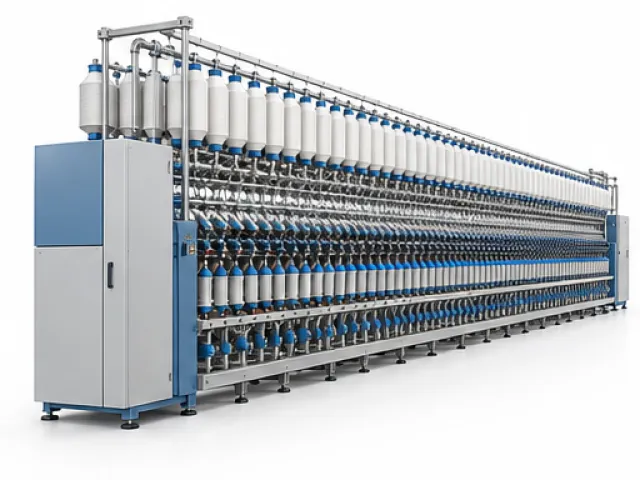
Xinchang Lilai Textile Machinery makes yarn twisting equipment in the Qingshan industrial area of Xinchang, Zhejiang. Its range covers 321-series short-staple two-for-one twisters, high-speed doubling machines, large-package twisters and direct twisters. Two models come with full data sheets. The LL321G short-staple twister is built in 16-spindle sections, up to 13 sections and 208 spindles at a 225 mm pitch. The LL528A direct twister is offered with 225, 254 or 290 mm spindle pitch and runs at up to 9,000 rpm. To get a quote, tell Lilai your fibre, count and ply, the twist and direction, and the package sizes going in and coming out.
Lilai sells two quite different kinds of twister, and the right one depends on where the yarn comes from. The LL321G is a two-for-one twisting machine for plied short-staple yarn: cotton, flax, wool and blends. The LL528A is a direct twister, where the feed package size and the size of the package you take off decide which of its three versions fits.
Both sit inside the wider yarn preparation stage of a spinning mill, after winding and before weaving or knitting. Lilai also mentions high-speed doubling machines in its company text, but publishes no data sheet for them, so ask for one if doubling is part of your plan.
Each model has its own figures. Quote requests go faster when they name one model and one configuration, rather than asking for a Lilai twister in general. [1][2][3]
02
LL321G: sections, spindles and speed ceilings
Lilai's Chinese heading and description present the LL321G as an intelligent short-staple two-for-one twisting machine for cotton, flax, wool and blended yarns. The English subtitle on the same sheet reads 'large diameter package spooler'. The parameters on the sheet are twisting parameters, so name the machine as a two-for-one twister in your enquiry and contract.
The frame grows sixteen spindles at a time to a ceiling of 13 sections, or 208 spindles, pitched at 225 mm. Pick the section count first. It sets the length of the frame, the number of feed packages you prepare and the output you can plan around. [2]
Swipe the table sideways to see every column.
LL321G: sections, spindles and speed ceilings
LL321G item
Published specification
What to settle with Lilai
Sections and spindles
16 per section; up to 13 sections / 208 spindles
The section count you want quoted and drawn.
Twist direction
S / Z
The direction your plied yarn needs, written beside the yarn construction.
Speed ceilings
Spindle: 12,000 rpm; line speed: 100 m/min
The spindle speed and delivery Lilai will run together at your twist.
Take-up
Tube 170–175 mm; wound diameter up to 250 mm
The tube drawing and the package your next process can unwind.
03
Break alarms, shift counts and the dust option
Yarn-break detection with alarm
Length counting and shift production display
Dust-removal device offered as an option
The LL321G watches for yarn breaks and raises an alarm. It counts yarn length and shows production by month, day and shift, and Lilai says the data can be sent to a computer system. The sheet names no protocol, file format or software licence. If you want the figures in your own mill software, ask Lilai to demonstrate the link with that system.
Lilai describes a dual-motor belt drive, a compact frame, polished spindles and a dust-removal device sold as an option. Ask whether the dust unit is in the price and what air or power it needs. Lilai also promises lower staffing and better yarn quality; ask for the figures behind those statements, or measure them yourself.
The yarn range is printed as 8S/2–140S/2. Ask which count convention the S stands for before you compare it with your own yarn data. A plied sample of the real yarn, with its target twist and twist direction, tells Lilai far more than a fibre name. [2]
04
LL528A: pick the pitch from your package sizes
The LL528A is Lilai's direct twister. It is built in three spindle-pitch versions, 225, 254 and 290 mm, and each one takes a larger feed package and builds a larger take-up package than the last. The table keeps the two ends of the machine apart: the package you load and the package you remove.
All three versions run at up to 9,000 rpm with manual threading and a dual-motor tangential-belt drive. Yarn tension can be set inside and outside the spindle. The sheet gives no table of yarn materials, counts and twists for each version, so send Lilai your yarn and let it say which pitch suits it. [3]
Swipe the table sideways to see every column.
LL528A: pick the pitch from your package sizes
LL528A version / pitch
Formed package diameter / length
Feed package diameter / weight
225 mm
Up to 170 / 155 mm
Up to 140 mm / 2 kg
254 mm
Up to 210 / 190 mm
Up to 160 mm / 2.5 kg
290 mm
Up to 230 / 210 mm
Up to 160 or 190 mm / 3–3.5 kg
05
Company background and a 2013 forming-device patent
Lilai's company page places it in Xinchang and names three product families: 321-series short-staple twisters, high-speed doubling equipment and large-package twisters. It says it exports to Southeast Asia and Africa. It names no customers there and no local service team, and its phrase 'more than ten years' carries no date. If service near your mill matters, ask who would handle it.
The Chinese utility-model publication CN202925199U, published on 8 May 2013, names Xinchang Lilai Textile Machinery Co., Ltd. as the patent holder. The address on its front page is in the Qingshan industrial area, the same area Lilai gives on its website. The patent covers an electronic forming device for a two-for-one twister that uses a synchronous belt and yarn-traversing rods.
The patent shows what Lilai was designing in 2013. It mentions a forming speed of 160 m/min, while the LL321G sheet itself lists 100 m/min as its line-speed ceiling. Plan on the catalogue figure, and ask Lilai whether the patented device is fitted to the LL321G or LL528A you are buying. A company profile like this one is a starting point for those questions. [1][4]
06
What to send Lilai before a price comes back
Quote preparation for Lilai twisters
A clear enquiry lets Lilai propose one machine and one configuration. Work through these points in order and attach them to the request. [2][3]
Name the model and size
For the LL321G, the number of sections. For the LL528A, the spindle pitch, chosen from your feed and take-up package dimensions.
Describe the yarn
Fibre or blend, count with its convention, ply construction, the twist you need and its direction.
Show the packages
Drawings of the feed package and tube, and the finished package your next process expects.
Ask for the layout
A drawing for the ordered machine, with operating aisles and service space, measured from one consistent set of dimensions.
Agree the sample run
Hold a sample run on your own yarn at an agreed operating point, record the measurements both sides will judge it by, and keep the samples.
List what the price covers
Drive and control package, dust handling, consumables, commissioning, training and service scope, each named on its own line.
Equipment & specifications
Published model or series information. Open the equipment record for its full scope and configuration notes.
Generic spinning machinery illustration · not the listed equipment
The LL321G is a short-staple two-for-one twisting machine for plied cotton, flax, wool and blended yarn. Frames grow in 16-spindle sections to 208 spindles, with spindle speed up to 12,000 rpm, delivery up to 100 m/min and take-up packages up to 250 mm across. Send a plied yarn sample, the twist per metre and direction you need, your feed package and tube drawings, and the number of sections you want quoted.
Checklist and notes are not uploaded or saved after reload. Copy or download a draft to keep it. Opening the workspace does not send this draft.
Sources & review
Specifications here come from Lilai's own product sheets and company page, and the patent detail from the 2013 publication. Nobody from the site has seen these machines run. Before ordering, ask Lilai to confirm in writing: one set of LL321G dimensions for your section count, the count convention behind the yarn range, the speed and twist it will hold on your yarn, whether the patented forming device and the dust unit are included, how production data leaves the machine, the basis of the LL528A energy figure, and the price, lead time and service terms for your country.