
RFRS30D · Rotor spinning
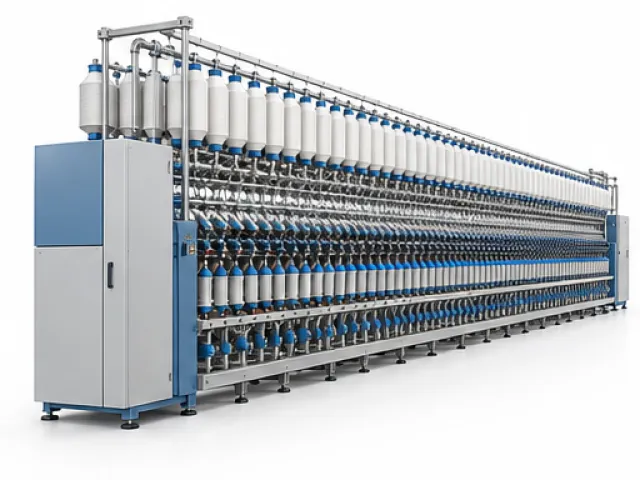
Equipment model · RFRS30D
The RFRS30D is a modular rotor spinning machine from Rifa, assembled in sections of 20 positions to a maximum of 600. Rotors run between 45,000 and 110,000 r/min and opening rollers between 6,000 and 10,000 r/min. It spins 120 to 15 tex (5 to 40 Ne) from 2.5 to 7 ktex sliver, with fibres up to 60 mm long. Packages reach 300 mm across and 4 kg, and the longest machine measures 77.8 m. Automatic doffing is an option. For a quote, send your fibre and sliver details, the yarn count and twist you need, the package type and the number of positions.
Manufacturer: Rifa Textile Machinery
- Spinning positions
- Up to 600, in sections of 20 at 230 mm pitch
- Rotor speed
- 45,000–110,000 r/min
- Yarn range
- 120–15 tex (5–40 Ne)
- Feed sliver
- 2.5–7 ktex, fibre up to 60 mm
- Full package
- Up to 4 kg; flat up to 300 mm, tapered up to 270 mm
- Installed power
- Up to 195 kW
- Automatic doffing
- Optional
Published specifications
Values below come from the maintained catalogue record. The guide review date does not renew an earlier specification: read the dated source notes and confirm a current, matched configuration before comparing products.
Swipe the table sideways to see every column.
| Parameter | Published value |
|---|---|
| Maximum rotor speed | 110000 rpm |
| Design delivery speed | 200 m/min |
| Piecing | Semi-automatic pneumatic piecing |
| Maximum positions | 600 |
| Feed sliver | 2.5–7 ktex |
Spinning range in Rifa's table
Rifa publishes the figures below for the RFRS30D, its open-end spinning machine. They mark the edges of what the machine can do. Your own fibre and yarn decide which rotor, opening roller and speeds you end up running, so ask Rifa for a recipe built from your material.
Yarn is given in both tex and Ne. If your mill works in another count system, convert before you compare offers. Twist is listed in turns per metre, the unit most rotor yarn specifications use. [1]
Swipe the table sideways to see every column.
| Parameter | Rifa's figure | Ask for your order |
|---|---|---|
| Rotor speed | 45,000–110,000 r/min | The speed Rifa proposes for your rotor and fibre; each side has its own drive and frequency control |
| Opening-roller speed | 6,000–10,000 r/min | A setting chosen for your feedstock and opening arrangement |
| Yarn count | 120–15 tex (5–40 Ne) | Expected yarn quality at your target count and blend |
| Fibre length | Up to 60 mm | Send your real staple length spread and fibre condition |
| Feed sliver | 2.5–7 ktex | Sliver weight, evenness and can format from your drawing frames |
| Draft | 20–280 | The draft that links your sliver to your yarn |
| Twist | 200–2,000 turns/m | Twist level matched to count and rotor choice |
| Opening-roller diameter | 65 mm | The roller type supplied and its spare-part code |
| Rotor diameters | 33, 34, 36, 40, 50 or 54 mm | Which diameter is fitted and its approved top speed |
| Pitch and section | 230 mm, 20 positions per section | Final section count and layout |
| Total positions | Up to 600 | The count you actually need for your output target |
Yarn delivery and winding settings
Rifa's specification table shows a maximum of 200 m/min under the heading Doffing Speed, while the feature text calls the same 200 m/min the yarn delivery speed. Read it as delivery speed and ask Rifa to correct the label in your offer. The time taken to change a full package is a separate figure.
For winding, the page lists a guide angle of 30 to 42 degrees and a tension draft ratio of 0.6 to 1.5. These are adjustment ranges. Ask Rifa which settings it recommends for your yarn and for the process that will unwind it, such as weaving, knitting or dyeing.
The electronic tension control is described with an adjustment step of 0.001, with no unit attached. Ask what that step refers to and, if tension matters for your downstream process, what tension in cN Rifa expects on your yarn. [1]
Cans, packages and the floor plan
The tube and bobbin rows on Rifa's website are incomplete, so they cannot serve as a tube drawing. Ask for the exact tube specification and a sample tube approved for the winding cradle before you order tubes locally.
The can sizes pair inch labels with metric figures that are not exact conversions, for example 20 inches with 530 mm. Take the permitted outer diameter from Rifa's drawing, not from the label. [1]
Swipe the table sideways to see every column.
| Item | Rifa's figure | Settle before ordering |
|---|---|---|
| Can height | 900 mm standard, 1,200 mm optional | Which height suits your drawing frames and can transport |
| Can diameter | 16 in/400 mm, 18 in/450 mm, 20 in/530 mm | Approved outer diameter and clearance between cans |
| Package diameter | Flat up to 300 mm, tapered up to 270 mm | Package shape and tube for the next process |
| Package weight | Up to 4 kg | The weight reachable with your yarn and package shape |
| Machine length | Up to 77.8 m | Length for your position count plus service aisles |
| Over 540 positions | Head end grows by 666 mm | A drawing for the exact length you order |
| Installed power | Up to 195 kW | A connected-load schedule for your configuration |
| Exhaust fan | Up to 2,000 m³/h, frequency regulated | Ducting, filtration and who supplies them |
Doffing, piecing and monitoring options
- Automatic doffing optional, quoted at 20 seconds per doff
- Synchronous piecing after a stop or power cut
- Online monitoring with remote upgrades
Rifa sells automatic doffing as an option. A feature panel quotes a standard doff within 20 seconds without saying how it was measured. Ask Rifa to name the doffing system in your offer, show it running, and define where that 20-second cycle starts and stops.
Other listed functions are pneumatic lifting, automatic piecing, synchronous piecing after a normal stop or a power cut, electronic tension and online monitoring with software upgrades. Get a list that marks each one as included or optional, and how it will be checked at sign-off at commissioning.
Connected functions need IT agreements. Settle who can reach the machine remotely, what network it needs, who supports it and how your mill approves a software update before it is installed. [1]
A trial on your own fibre
Rifa describes good trash removal and yarn quality on this machine. A run with your own sliver is the way to see that on your blend. These six steps keep the trial comparable with other offers. [1]
Fix input and target
Send fibre or blend and its condition, sliver count, target count and twist, and what the yarn will be used for.
Note the setup
Write down rotor and roller types, speeds, draft, twist, winding settings and how many positions run.
Choose yarn tests
Pick the count, strength, evenness, imperfection and joint tests that matter to you, with sampling and pass limits.
Spin a full run
Use representative sliver and log stops, waste and accepted output over the agreed period.
Check joints and packages
Unwind real packages, ideally on your own downstream machine, and inspect the pieced joints.
Prove the automation
Run the doffing and restart functions you are paying for and keep the record.
Site services and handover
The weight row on Rifa's site gives a head, section and tail formula instead of a number. Ask for the final machine mass and floor loading before planning freight or foundations.
Agree the electrical supply, compressed air for the pneumatic functions, extraction and filtration, can circulation and service access. The 195 kW and exhaust figures cover only part of that design. Ask for the connected load of the exact machine quoted.
At handover, collect the wear-part list for rotors and opening rollers, cleaning instructions, a backup of the software and settings, operator training and the commissioning record. If energy per kilogram matters, agree how it will be measured and on which material, since installed power alone cannot give that figure. Putting two offers side by side only works once both include these items. [1]
Prepare a useful enquiry
Check the information you have ready. Your selections stay on this device as a draft; nothing is sent to a manufacturer.
0 of 8 items ready
Open enquiry workspace →Checklist and notes are not uploaded or saved after reload. Copy or download a draft to keep it. Opening the workspace does not send this draft.
Sources & limitations
All figures come from Rifa's RFRS30D page. Get written answers from Rifa on each item below before you order: the rotor, roller and speeds for your fibre and yarn, the corrected label for the 200 m/min figure, the tube drawing and can outer diameters, the machine mass and drawing for your position count, which doffing and connected functions are included, the yarn-quality limits for acceptance, and the connected load and air and extraction needs of the machine quoted.
RFRS30D official specifications, installation note and feature descriptions
RIFA Textile Machinery · Undated; accessed 11 October 2026
The full RFRS30D table: speeds, yarn and sliver ranges, cans, packages, length, power and exhaust, plus the installation note and feature panels on doffing, piecing and monitoring.
Each source above lists its publisher and the date it was checked. Editorial method · Report an outdated detail