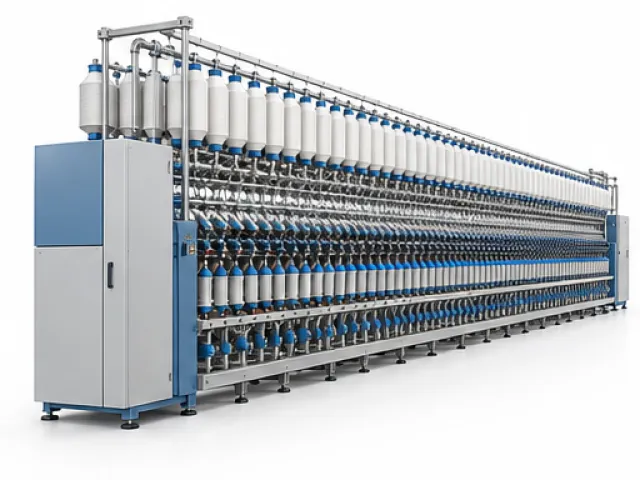
Zhejiang Rifa Textile Machinery, based in Xinchang, sells machines for most stages of textile production: opening and carding, rotor and vortex spinning, winding and twisting, several types of loom, circular and seamless knitting, hosiery and nonwovens. Two models stand out for buyers. The RFRS30D rotor spinner is built in sections of 20 positions up to 600, with rotor speeds from 45,000 to 110,000 r/min. The RFJA32 is an air-jet loom adapted for glass-fibre yarn. To start a quote, tell Rifa which model you want, the fibre or glass yarn you will run, the yarn or fabric you need and how large the line should be.
Crosrol-linked assets bought in 2018 for opening and carding
Rifa dates its start to 1993. In 2005 it bought Shandong Changrun and set up Shandong Rifa. Anhui Rifa followed in 2013, and production began at the Anhui industrial park in 2015. The first phase of the Xinchang industrial park opened in 2016.
Two later deals shaped the range. In 2018 Rifa acquired assets linked to Crosrol, which it ties to its opening and carding machines. In 2021 it took over a hosiery-machine project. That is why one catalogue now runs from fibre preparation through yarn, fabric and socks to nonwoven lines.
Because the group works from several locations, ask which site builds the model you are pricing and which team will install and service it. Put both names in the contract. The guide to manufacturer profiles lists other company details worth collecting before you sign. [1]
02
RFRS30D: buying a rotor spinning section
Up to 600 positions, built in sections of 20
45,000 to 110,000 r/min rotor speed
Separate drives for the two machine sides
Doffing robot offered as an option
The RFRS30D is Rifa's rotor spinner. A machine is assembled from sections of 20 positions and can reach 600 in total. Rotors turn at 45,000 to 110,000 r/min, and each side of the machine has its own drive. Feed sliver can be 2.5 to 7 ktex. Full technical tables are on the RFRS30D equipment page.
Rifa offers several rotor diameters and fits a 65 mm opening roller. Choose the rotor for your fibre and the yarn you want, and let Rifa propose the speed that suits that pairing. Quotes from different suppliers only line up when each is priced on a like-for-like configuration, with the same rotor, roller and position count.
Automatic doffing is sold as an option. Rifa also describes electronic winding-tension adjustment, pneumatic lifting and online monitoring. Ask for a line-by-line list of what your offer includes, since some of these functions depend on the option package and control version you order. [2]
03
What the RFRS30D needs from your building
Long rotor machines take a lot of floor and a lot of cans. The table below lists the published layout details and what to settle with Rifa before you design the hall, can routes and electrical supply. [2]
Swipe the table sideways to see every column.
What the RFRS30D needs from your building
Published detail
Settle with Rifa
Beyond 540 positions the installation drawing adds 666 mm to the machine
The drawing for your exact position count, with head-end length and walkways
Sliver cans of 16, 18 or 20 inches; 900 mm high as standard, 1,200 mm as an option
Which can size and height suit your drawing frames and transport route
Installed power up to 195 kW
The connected load for your configuration and the expected running demand per shift
04
RFJA32: an air-jet loom built for glass yarn
Main, auxiliary and stretch nozzles for glass weft
Four-link beating and electronic let-off
Servo winding to 800 mm roll diameter
Built-in suction for fine glass fibres
Glass yarn is brittle and sheds fine fibres, and the RFJA32 is Rifa's air-jet loom adapted for it. Weft insertion uses adapted feeders with main, auxiliary and stretch nozzles. A four-link mechanism drives the beating, electronic let-off works with a double back rest, and the loom carries its own cutting scissors.
On the take-up side, the cloth-handling rollers are covered with special friction materials meant to prevent pressure marks. A servo-controlled winder builds rolls up to 800 mm in diameter. Suction removes the fine fibres released during weaving.
To price an RFJA32, send the glass-yarn specification, the weave, the fabric width and the defects you will reject. Ask Rifa for the reed width it offers, the compressed-air demand and how the suction connects to your extraction system. If Rifa quotes lower yarn damage or longer part life, ask for the test conditions and the machine used as the baseline. [3]
05
Rifa's part in a seamless knitting standard
China's national standards information platform lists Rifa, under its earlier Chinese company name, among the drafters of FZ/T 97024-2010. That industry standard covers computerized seamless underwear knitting machines. It was published on 16 August 2010 and took effect on 1 December 2010.
This record relates to Rifa's seamless knitting work. It tells a buyer nothing about the rotor spinner or the glass-fibre loom, so treat it as background on the company's knitting experience. [4][5]
06
Trials that fit each machine
For an RFRS30D, run a trial on your own fibre with the sliver you will actually feed and the yarn and package you need at the end. Log output over an agreed period, the yarn-quality limits, stops, and the labour spent on piecing and doffing. If you are comparing automation levels, keep the fibre mix and shift pattern identical for each.
For an RFJA32, build the demonstration around your glass yarn, the finished fabric and the way rolls leave the loom. Agree beforehand which faults fail a roll. Keep the loom's own result apart from the compressed air and extraction your plant supplies, so each side knows what it answers for.
Write the same criteria into the acceptance test at Rifa's works and again at your site. A brief run at top rotor speed says little about a full shift of saleable yarn, so set the run length with Rifa in advance. [2][3]
07
Other Rifa lines to ask about
Beyond the two featured models, Rifa's range covers opening and carding, vortex spinning, winding and twisting, several loom types, circular and seamless knitting, hosiery and nonwoven lines. If you are planning a full mill or adding a stage before or after a rotor spinning line, list every process you need priced and ask which group site supplies each one.
Buyers of seamless knitting or sock machines can start from the knitting standard section above. For weaving beyond glass fibre, ask Rifa to send the loom models that match your yarn and width, and compare them on the same terms as the RFJA32. [1]
Equipment & specifications
Published model or series information. Open the equipment record for its full scope and configuration notes.
Generic spinning machinery illustration · not the listed equipment
The RFRS30D from Rifa is a rotor spinning machine built in 20-position sections up to 600 positions. Rotor speed spans 45,000–110,000 r/min, yarn covers 120 to 15 tex (5 to 40 Ne), and the machine takes 2.5 to 7 ktex sliver of fibres up to 60 mm. Packages reach 4 kg; automatic doffing is optional. For a quote, send your fibre, sliver count, target yarn and twist, and the number of positions.
Checklist and notes are not uploaded or saved after reload. Copy or download a draft to keep it. Opening the workspace does not send this draft.
Sources & review
Company and machine details come from Rifa's own company and model pages; the standards entries come from the national standards information platform. Before ordering, ask Rifa to confirm in writing: the site that builds your model and the team that installs it, the rotor, roller, position count and automation in your RFRS30D offer, the drawing and connected load for that configuration, the reed width, air demand and extraction connections for an RFJA32, the test basis for any yarn-damage or part-life figures, and the price and delivery date for your order.
Company profile and development chronology
Rifa Textile Machinery · Manufacturer publication
Rifa's history from 1993, its Xinchang, Shandong and Anhui businesses, and how each product family was added.
Publication: Not dated · Reviewed: 2026-10-07
RFRS30D rotor spinning machinery: specifications and features
Rifa Textile Machinery · Manufacturer publication
Positions, rotor speeds, sliver range, installation note, can sizes, installed power and the optional doffing system.
Publication: Not dated · Reviewed: 2026-10-07
RFJA32 glass-fibre weaving machine: features
Rifa Textile Machinery · Manufacturer publication
Weft insertion, beating, let-off, cloth handling, roll winding and fibre suction on the glass-fibre loom.
Publication: Not dated · Reviewed: 2026-10-07
FZ/T 97024-2010 official industry-standard record
National Public Service Platform for Standards Information · Independent institutional record
The drafting list with Rifa's earlier company name, plus publication, implementation and withdrawal dates for the seamless knitting standard.
Publication: 2010-08-16 · Reviewed: 2026-10-07
FZ/T 97024-2025 official replacement-standard record
National Public Service Platform for Standards Information · Independent institutional record
The 2025 edition that replaces the 2010 standard, with its 1 August 2027 start date.