
RS-615F / RS-616F
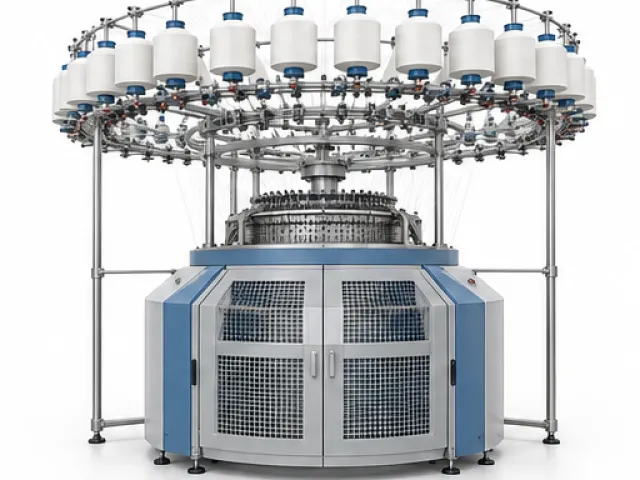
Equipment series · RS-615F / RS-616F
The RS-615F and RS-616F are integrated sock machines: each one knits the sock, closes the toe stitch to stitch, then turns the sock before discharge. Both accept a 3.5- or 3.75-inch cylinder with 84–220 needles, rated at 350 rpm for plain and 300 rpm for terry. Patterning is where they part: the RS-615F carries eight piezoelectric selectors and the RS-616F nine. A patterned-terry RS-616DF shares the product page. To have the right version quoted, send your yarn, sizes and sock design.
Manufacturer: Zhejiang Rosso Equipment Manufacturing Co., Ltd.
- Cylinder
- 3.5 or 3.75 inch
- Needles
- 84–220
- Speed
- Plain 350 rpm, terry 300 rpm
- Selectors
- RS-615F eight, RS-616F nine (8-segment piezoelectric)
- Operations
- Knit, close toe, turn
- Yarn-break sensors
- Fifteen, optical
- Lubrication
- 3.5-litre pneumatic filtered circulation
Published specifications
Values below come from the maintained catalogue record. The guide review date does not renew an earlier specification: read the dated source notes and confirm a current, matched configuration before comparing products.
Swipe the table sideways to see every column.
| Parameter | Published value |
|---|---|
| Cylinder diameter choices | 3.5 or 3.75 in |
| Needle count range | 84–220 |
| Listed plain knitting speed | 350 rpm |
| Listed terry knitting speed | 300 rpm |
Three versions on one product page
- Line up the three configurations against your sock design rather than the series title.
Rosso titles the page RS-615F/616F and adds a row for RS-616DF. The structures listed for the series as a whole do not all apply to every version. Selective terry sits with the RS-616DF, so ask for that model by name if your socks need terry in chosen zones. [1]
Swipe the table sideways to see every column.
| Version | Cylinder and needles | Speed by structure | Selection system |
|---|---|---|---|
| RS-615F, plain/terry | 3.5 or 3.75 inch, 84–220 needles | 350 rpm plain, 300 rpm terry | Eight piezoelectric selectors of 8 segments |
| RS-616F, plain/terry | 3.5 or 3.75 inch, 84–220 needles | 350 rpm plain, 300 rpm terry | Nine piezoelectric selectors of 8 segments |
| RS-616DF, selective terry | 3.75 inch, 108–200 needles | 300 rpm all-plain, 250 rpm selective terry | Nine of 8 segments plus one of 6 segments |
From knitting to a turned sock
On the integrated route, the knitted sock passes to toe closing and then to turning inside the same machine. Rosso also describes an open-toe mode that skips closing and turning. Pick one mode for the quotation and the acceptance sample, and say whether you will switch between them in production.
Time the integrated route from the first course to discharge of the closed, turned sock. Log transfer, closing, turning, stoppages and rejects as separate entries where the controller allows. Knitting rpm alone tells you nothing about pairs per shift. Mills running single-function sock knitters can set this time against their present knit-then-close route.
If you plan open-toe output, name the machines that will close and turn those socks and check their capacity. An open-toe demonstration may look quicker, yet it moves the closing work elsewhere, so it says nothing about integrated output or labour savings. [1]
Checking the closed toe
Stitch-to-stitch closing is the feature to examine on real socks. Before the trial with your production yarns, decide how you will grade dropped or missed stitches, the seam line, opening under stretch, loose tails and bulk at the seam.
Look at each sock inside and out once it is turned. Then put it through your usual boarding and washing or conditioning, and compare size, appearance, seam stability and the areas that touch the skin with the approved sample. Catalogue photos cannot show how a seam feels or lasts.
Include every size and the hardest colour or structure changes. If you knit sleeves or knee supports, check their shape and fit; being able to knit them says nothing about medical or protective performance. [1]
Yarn feeds, sensors and drives
Yarn reaches the needles through nine main fingers on a single main feed, two elastic fingers on the elastic feed, and eighteen auxiliary fingers spread across six further feeds. Rosso does not present these counts as a ceiling on colours knitted at once. Ask for a yarn-finger map drawn on your own pattern.
Fifteen optical sensors halt knitting when a yarn breaks. Find out which yarn paths they watch, how the machine responds, and how the operator restarts both during knitting and during transfer and closing. Other faults can still slip through, so keep your own checks.
Motion comes from three size-42 and thirteen size-57 stepper units, listed without full electrical ratings. The main motor is printed as 1.78K with the unit cut off, so the page gives no kW figure or connected load; ask for the nameplate data. [1]
Utilities and site preparation
Rosso prints these as requirements for customers. Use them to start site planning, and follow the documents shipped with your machine for installation and safety. [1]
Swipe the table sideways to see every column.
| Item | Rosso figure | What to obtain |
|---|---|---|
| Electrical supply | 380 V ±38 V, 50–60 Hz; stabiliser and sound earthing asked for | Phases, full load, protection and the nameplate. The 1.78K motor entry is incomplete. |
| Compressed air | 0.62–0.65 MPa, free of contaminants, oil and water | Air flow, duty and quality for the number of machines you plan. |
| Air/suction pressure | More than 5.5 kPa | Where it is measured, the flow needed, and who supplies blower and ducting. |
| Lubrication | 3.5-litre pneumatic filtered circulation | Reservoir service steps and the lubricants Rosso approves. |
| Air cleaning | Cuff, suction inlet, sock-tube bend and yarn-disc lint points | Add these to the total air demand; no consumption figure is printed. |
| Space and handling | No footprint or weight table on the page | Installation, service-access and shipping drawings for your build. |
A sock-based acceptance plan
Keep knitting speed and finished output apart in the contract. The steps below give a counted handover built on your own socks. [1]
Freeze the build
Write down model, cylinder, needle count, yarns, pattern and the output mode.
Approve the program
Agree structures, yarn-finger mapping, size changes, and delivery of editable pattern files and backups.
Run the full cycle
For an agreed period, count accepted socks, rejected pieces and every transfer, closing or turning stop.
Inspect after finishing
Check seam, dimensions and appearance after your finishing or wash route. Keep labelled samples.
Show fault recovery
Following Rosso procedures, demonstrate the yarn-break response, a controlled restart and program restore.
Close the handover
File settings, utility readings, the wear-part list, training records, warranty terms and the agreed limits.
Prepare a useful enquiry
Check the information you have ready. Your selections stay on this device as a draft; nothing is sent to a manufacturer.
0 of 8 items ready
Open enquiry workspace →Checklist and notes are not uploaded or saved after reload. Copy or download a draft to keep it. Opening the workspace does not send this draft.
Sources & limitations
Before ordering, ask Rosso to confirm in writing: the version and selector layout, whether your structures and terry placement suit it, the output mode, a complete power, air-flow, suction and lubricant schedule, and the finished-sock output of a counted run. The rpm figures on the page are knitting speeds only.
RS-615F/616F integrated sock machine: specification, configuration and customer requirements
Zhejiang Rosso Equipment Manufacturing · 3 March 2025; accessed 11 October 2026
Model and configuration tables, the functional description and customer site requirements for the series. The page also carries the RS-616DF row.
Each source above lists its publisher and the date it was checked. Editorial method · Report an outdated detail