Zhejiang Rosso Equipment Manufacturing builds sock machines in Zhuji, Zhejiang. Its headline range is the RS-615F/616F integrated series, which knits a sock, links the toe stitch to stitch and turns it on one machine, with a sister model, RS-616DF, for patterned terry. The wider catalogue covers 7F/8F cotton-sock machines, fine hosiery, three-dimensional knitting and separate toe-closing and turning machines. For a quotation, send your yarns, sock designs and sizes, and name the model, cylinder and needle count you want priced.
Rosso works in hosiery machinery. Its company introduction covers development, manufacture, sales and service, and names machining centres and CNC lathes among its own workshop plant. Most sock mills will start with the integrated series, because it puts knitting, toe linking and turning on a single frame.
Beyond that series the catalogue reaches 7F/8F cotton-sock machines, fine-hosiery equipment, three-dimensional knitting, and stand-alone toe-closing and turning machines. A mill that wants to keep its present knitters can price the closing and turning machines by themselves. Set any of them beside hosiery knitting machines listed by other makers, and ask Rosso which items your offer actually includes, since a long catalogue does not put a whole line into one quote.
The introduction page shows a 2020 date yet carries later material. If headcount, plant totals or market share matter to your supplier approval, ask Rosso for current figures. It also helps to know how to weigh a maker's own company page against outside records. [1]
02
How the RS series handles a sock
Rosso names three operations inside one machine: knitting, stitch-to-stitch toe linking and turning. The same machine can make open-toe socks with linking and turning left unused, so tell Rosso which output your order needs. The full cylinder, needle and speed data sits on the RS-615F/616F equipment page. [2]
Knitting
Plain, terry or patterned-terry construction, depending on the model, on the cylinder and needle count that suit your yarn and design.
Toe linking
The toe is joined stitch to stitch on the machine. Judge the seam on socks knitted from your own yarn.
Turning
The sock is turned before it leaves. Boarding, pairing and packing happen elsewhere, so agree who supplies that equipment.
Open-toe option
With linking and turning switched out, the machine delivers open-toe socks for a separate closing route.
03
RS-615F, RS-616F and RS-616DF side by side
Rosso's table treats RS-615F/616F as dual-purpose plain and terry machines and RS-616DF as the patterned-terry model, called 任意毛圈 in Chinese. Speed changes with the fabric structure. These are knitting speeds in rpm, so a rate for finished socks has to come from a counted run. [2]
Swipe the table sideways to see every column.
RS-615F, RS-616F and RS-616DF side by side
Model
Cylinder and needles
Knitting speed
Selectors
RS-615F
84–220 N; 3.5 or 3.75 inch cylinder
Plain 350 rpm; terry 300 rpm
Eight 8-stage piezoelectric
RS-616F
84–220 N; 3.5 or 3.75 inch cylinder
Plain 350 rpm; terry 300 rpm
Nine 8-stage piezoelectric
RS-616DF
108–200 N on a 3.75 inch cylinder
All-plain 300 rpm; patterned terry 250 rpm
Nine 8-stage plus one 6-stage
04
Feeds, selectors and yarn-break stops
RS-615F has eight 8-stage selectors, RS-616F nine, and RS-616DF nine plus one 6-stage unit.
The series page describes a single feed layout: a main feed with nine main yarn fingers, an elastic feed with two elastic fingers, and six auxiliary feeds carrying 18 auxiliary fingers between them. Fifteen photoelectric sensors stop the machine on a yarn break, and air blowing keeps several yarn and sock-handling points clear.
Rosso lists plain, terry, patterned terry, jacquard, tuck, mesh and several welt structures for the series. The model table narrows that list for each machine, so send your artwork and terry placement and have Rosso say which model knits it. Selector counts describe patterning hardware; ask Rosso to map your colours onto the yarn fingers using your own design. [2]
05
Power, air and extraction
Rosso's customer notes give three utility figures. Pass them to your electrician and plant engineer early, and get the wiring and layout drawings for the configured machine before you prepare the floor. [2]
Swipe the table sideways to see every column.
Power, air and extraction
Service
Published requirement
Electrical
380 V ±38 V at 50–60 Hz, with voltage stabilization and proper grounding
Compressed air
0.62–0.65 MPa, clean and free of oil and water
Extraction
Above 5.5 kPa; airflow and connection to be agreed with Rosso
06
Outside records of the company
Jiyang College of Zhejiang A&F University reported on 4 January 2024 that it had visited Rosso on 2 January. The talks covered coursework and practical teaching, such as taking machines apart, running them and assembling components. The report describes the visit and its topics; ask Rosso whether any training arrangement followed.
In March 2025 Rosso announced that it had received Zhejiang Made certification. The announcement gives little certificate detail. If the mark matters to your own customers, ask Rosso for the certificate, its current status and the products it covers. [3][4]
07
From enquiry to an accepted machine
With an integrated machine you are paying for finished socks, so plan the purchase around them. Send yarns and artwork with the enquiry and keep the same set for a trial on your own yarn.
Rosso says the integrated design saves labour and shortens delivery. Put a number on that only against your current line, measured the same way. [2]
Send the brief
Model, cylinder, yarns, sizes, artwork and the output mode you want priced.
Watch a full cycle
Time knitting, transfer, linking and turning together, and count accepted socks, rejects and stops.
Check the toe and the turn
Look at the linked toe and the turned sock against your reference before agreeing any rate.
Test recovery
Have the operator clear a yarn break or a stalled handoff and show how the affected piece is marked.
Fix the offer
Write in utilities, auxiliary equipment, training, spare parts, service and acceptance terms, and attach the sample report.
Equipment & specifications
Published model or series information. Open the equipment record for its full scope and configuration notes.
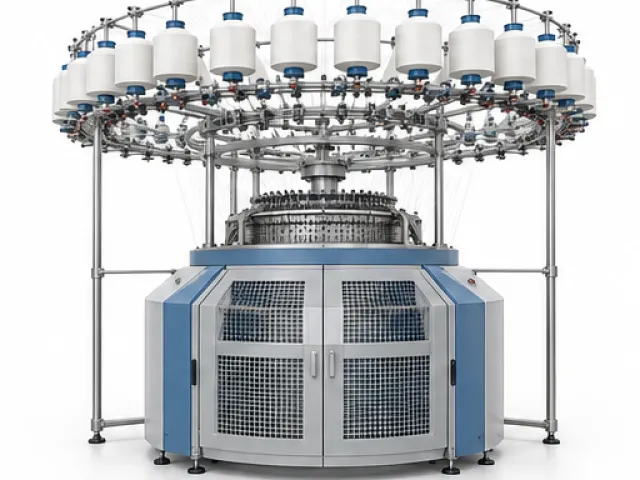
Generic knitting machinery illustration · not the listed equipment
The Rosso RS-615F and RS-616F knit a sock, close the toe stitch to stitch and turn it before discharge. Both take a 3.5- or 3.75-inch cylinder with 84–220 needles; listed speeds are 350 rpm for plain and 300 rpm for terry. The RS-615F has eight piezoelectric selectors, the RS-616F nine. Send yarn, sizes, sock design and output mode, and ask for a counted full-cycle run.
Checklist and notes are not uploaded or saved after reload. Copy or download a draft to keep it. Opening the workspace does not send this draft.
Sources & review
Before any deposit goes to Zhuji, Rosso should state in writing the model and selector layout, the structures it will knit on your design, the output mode, the utility schedule for the configured machine, and a finished-sock rate from a counted run on your yarn. The founding year and technical figures come from Rosso's own pages. Request the Zhejiang Made certificate itself if your buyers need it.
The integrated sequence, the open-toe mode and the model table with cylinders, needles and speeds. It also gives selectors, feeds and utility requirements.
Publication: 2025-03-03 · Reviewed: 2026-10-07
China Datang Hosiery Art College visit to Zhejiang Rosso
Jiyang College of Zhejiang A&F University · Independent institutional record
The college's account of its January visit and the teaching topics discussed with Rosso.
Publication: 2024-01-04 · Reviewed: 2026-10-07
Company announcement of Zhejiang Made certification