
SJ758 · Rapier loom
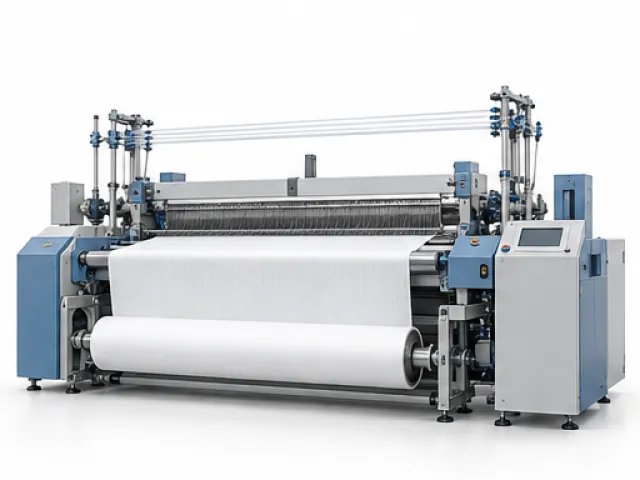
Equipment model · SJ758
The SJ758 is a rapier loom adapted to weave paper cord, nylon filament and mat grass. A PLC runs it, with automatic weft finding, a weft-break stop, multicolour weft selection and semi-automatic oil supply. Its first parameter block gives four to six weft colours, a 300 mm maximum cloth roll, 1.5 kW and 1,600 kg, while a second block on the same page lists different widths and 180–230 rpm. Before pricing, send a cord sample, the fabric you want and your reed width, and ask for the paper-cord sheet that matches that version.
Manufacturer: Shaoxing Textile Machinery Group
- Materials listed
- Paper cord, nylon filament and mat grass
- Control
- PLC, automatic weft finding, stop on weft break
- Weft selection
- Four to six colours (block one); six (block two)
- Cloth roll
- 300 mm maximum (block one); 400 take-up (block two)
- Power and weight
- 1.5 kW and 1,600 kg (block one)
- Speed
- 200/180/120 (block one); 180–230 rpm (block two)
Published specifications
Values below come from the maintained catalogue record. The guide review date does not renew an earlier specification: read the dated source notes and confirm a current, matched configuration before comparing products.
Swipe the table sideways to see every column.
| Parameter | Published value |
|---|---|
| Weft insertion | Rapier |
| Intended material | Paper cord |
| Control | PLC with weft finding and weft-break stop |
Paper cord, nylon filament and mat grass
Shaoxing Textile describes the paper-cord SJ758 as an adaptation of one of its existing looms. The three materials it names differ widely, and the page prints no shared diameter range, conditioning rule or speed for them.
Give the sales engineer the build and size of your material, how it arrives on feed packages, its moisture state and a length of it to test. Add the weave, fabric width, colour sequence and what the finished cloth is used for. If humidity changes how your cord runs, agree how it will be measured and noted during the trial.
The same catalogue lists an SJ758 metal-wire loom and coarse-yarn versions with longer suffixes. They are different machines. Make sure the quotation names the paper-cord application and its version in full. [1] [2]
Every published figure, and the sheet to request
The homepage entry and the product-index entry print the same two blocks. Use this table to see where each figure sits, then ask for one sheet covering your width, speed, density, colours and take-up. That single sheet is also what lets you compare configuration against configuration when a second supplier quotes. [1] [3]
Swipe the table sideways to see every column.
| Item | Published figures | Ask for |
|---|---|---|
| Width and speed | Block one groups 1800–2000, 2200–2300 and 3300 next to a single speed cell of 200/180/120; block two has another width list and 180–230 rpm | The paper-cord width you are buying, its units and the speed allowed on your cord. |
| Weft density | Block one shows a garbled symbol in front of 10 picks/cm | The correct figure, whether it is a minimum or maximum, and how it is measured. |
| Weft colours | Block one: four to six; block two: six | The selector and feeders actually fitted, shown running your colour sequence. |
| Cloth roll | Block one: 300 mm maximum diameter; block two: 400, with no unit on that line | The take-up fitted, its limit and how it handles a roll of your cloth. |
| Shedding and materials | Block one offers GT221 or GT222; block two lists cotton, wool and filament ranges, upper and lower warp beams and pile formation | A paper-cord build. Ask why any terry or yarn items appear in the offer. |
| Power, weight and size | Block one: 1.5 kW, 1,600 kg and a size row for the 1800 version, printed without units | Which version each figure covers, plus a current installation drawing and load list. |
Seeing the controls work on your cord
The controls listed are PLC operation, automatic weft finding, a stop after a weft break, multicolour selection and semi-automatic oil supply. Ask which controller and sensors are fitted and how the stop and restart sequence runs. Ask too which repair steps stay with the operator after each break.
During the trial, have the supplier's technician break a weft on purpose, run a colour change and bring the loom back to good cloth by the operating manual. Time each step and note what the operator has to do by hand.
Semi-automatic oiling still needs a routine. Ask for the lubrication chart, the oil grade, refill points and the access space a fitter needs around the drive. [1]
From cord sample to accepted cloth in five steps
The maker publishes no trial result or guaranteed output for paper cord. Agree a test like this before the order, and reuse it at commissioning so the loom in your hall matches the one that passed. [1]
Lock the sample and set-up
Record the cord lot, build, size, moisture state and packages. Note the loom width and version, shedding, feeders, colour selector and take-up.
Run feeding and insertion
Weave your colour sequence with your cord. Log each feeding problem, break and stop, and every operator adjustment, against the settings in use.
Judge the woven cloth
Agree width, structure and the visual or functional limits that matter. Cut samples by a fixed method, including cloth woven just after a stop.
Count good metres
Over a stated run time, count accepted cloth, rejects, waste and interruptions. Note speed, cord condition and settings beside the totals.
Repeat at your plant
Bring the approved samples and settings to installation, close any gaps and attach the repeatable procedure to final acceptance. Name who supplies any extra preparation or handling gear.
What the SJ758 offer should list
Ask for an itemised list of the feeders, insertion parts, shedding unit, colour selector and cloth take-up in the paper-cord package. The offer should also say whether the cord needs preparation, conditioning or extra handling before or after weaving, and who provides that equipment.
Request a current installation drawing with units, the electrical and utility loads and the space needed for operators and maintenance. The 1.5 kW figure belongs to block one only, so plan supply from the drawing and the installed power list for your version.
Put commissioning, training, manuals, lubrication and wear parts, warranty and delivery into the contract. The SJ758 page also mentions an older patent; if it matters to you, get the number and look up its current status. Price and running cost come only from the quotation. [1] [3]
Prepare a useful enquiry
Check the information you have ready. Your selections stay on this device as a draft; nothing is sent to a manufacturer.
0 of 8 items ready
Open enquiry workspace →Checklist and notes are not uploaded or saved after reload. Copy or download a draft to keep it. Opening the workspace does not send this draft.
Sources & limitations
Data on this page comes from two addresses of the SJ758 paper-cord page and the rapier product index. Nobody from the site has run the loom. Before ordering, ask Shaoxing Textile Machinery Group to confirm in writing: the single parameter sheet for your width and version, with units for width, speed, density, roll size and dimensions; the colour selector, shedding and take-up fitted; the output it will hold on your cord; the full scope of feeders and preparation gear; the patent status if relevant; and the price, delivery, warranty and spare parts terms.
SJ758 paper-cord rapier loom, homepage description
Shaoxing Textile Machinery Group · Undated; accessed 11 October 2026
Named materials and the PLC and weft functions. It prints two technical blocks, with widths and speeds grouped in one row and a garbled density symbol.
Current rapier-loom product index
Shaoxing Textile Machinery Group · Undated; accessed 11 October 2026
Separate entries for the paper-cord, metal-wire and coarse-yarn versions of the loom.
SJ758 entry linked from the current product index
Shaoxing Textile Machinery Group · Undated; accessed 11 October 2026
The same two technical blocks as the homepage description, plus a photograph of the machine.
Each source above lists its publisher and the date it was checked. Editorial method · Report an outdated detail