
WSF200A · Precision winding
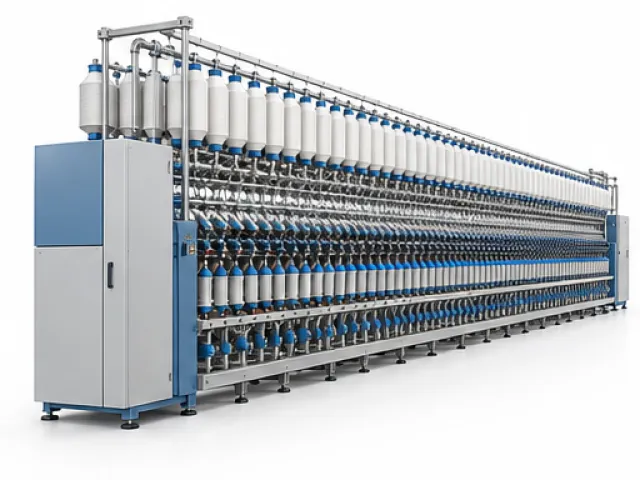
Equipment model · WSF200A
The WSF200A is an electronically guided precision winder with programmable package formation and digital tension feedback. It handles yarns from 10 to 7000 dtex and forms packages as large as 280 mm in diameter, weighing 5 kg, on cylindrical or conical tubes. Spindles sit on one side, six per section, from 6 to 60 per machine. Line speed is quoted at up to 1000 m/min, subject to process settings. The spec table and the feature list disagree on whether active unwinding is standard, so settle that in the offer before any trial.
Manufacturer: Zhejiang Wanshifa Textile Machinery Co., Ltd.
- Spindles
- 6–60; six per section, single-sided
- Yarn range
- 10–7000 dtex
- Line speed
- Up to 1000 m/min, process-dependent
- Traverse
- 25–260 mm
- Package
- Up to 280 mm diameter, up to 5 kg
- Power
- About 300 W per spindle
- Active unwinding
- Standard or optional: confirm in the offer
Published specifications
Values below come from the maintained catalogue record. The guide review date does not renew an earlier specification: read the dated source notes and confirm a current, matched configuration before comparing products.
Swipe the table sideways to see every column.
| Parameter | Published value |
|---|---|
| Spindles per section | 6 |
| Spindle configuration | 6–60 |
| Traverse range | 25–260 mm |
| Maximum package diameter | 280 mm |
| Stated maximum winding speed | 1000 m/min; process dependent |
What the WSF200A does
Wanshifa builds the WSF200A to lay yarn onto a tube in a programmed pattern. An electronic guide controls the traverse, so package shape is set in software, and a digital feedback loop holds winding tension. You can run it in digital or precision winding mode.
The listed yarns run from textured and straight filament to staple, elastic, silk and industrial yarn. Packages often go on to twisting, warping, knitting or weaving, and the build that suits one of those may not suit another. Tell the maker which machine takes the package next. [1]
Published WSF200A figures
Each value is an upper or outer limit from the model page. One yarn will rarely reach top speed and the largest package at once, so ask for a recommended process for your yarn and package. [1]
Swipe the table sideways to see every column.
| Item | Wanshifa figure | Match against |
|---|---|---|
| Yarn range | 10–7000 dtex | Your yarn's material, construction and how it behaves under tension. |
| Yarn types named | Textured and straight filament, staple, elastic, silk, industrial yarn | Ask whether your exact yarn has run on this model. |
| Winding mode | Digital or precision | The mode supplied and the recipe for your job. |
| Line speed | Up to 1000 m/min, depending on process parameters | The speed accepted for your target package. |
| Traverse | 25–260 mm | Tube length and usable winding stroke. |
| Package diameter | Up to 280 mm | Clearance and allowed build on your tube. |
| Package weight | Up to 5 kg | Yarn density and package geometry; the two maxima may not occur together. |
| Tubes | Cylindrical or conical | A tube drawing and the cradle that holds it. |
| Layout | Single-sided; 6 spindles per section; 6–60 in all | An installation drawing of the ordered build. |
| Pitch and drive | 360 mm pitch; each spindle driven on its own | Operator access and the control scope. |
| Installed power | About 300 W per spindle | The full site supply schedule and real consumption. |
Pin down the active-unwinding device
The WSF200A spec block marks active unwinding as fitted and lists no optional device. Feature 5 on the same page says the device can be chosen as an option. The page gives no reason for the difference, which may come from separate builds or an older revision.
Ask for an itemised offer that names the feed package, the active-unwinding mechanism, how it is controlled together with winding, and the parts fitted at each spindle. Have the supplier say which of the two page statements matches the machine quoted.
Wanshifa says yarns that are hard to unwind are handled well. Check that on the quoted build with your own supply packages, above all when sticky, elastic or badly built packages cause trouble today. [1]
Tension targets and saved recipes
The model page describes real-time digital tension control with feedback and programmable package shape. It prints no tension range, accuracy, sensor calibration method or recipe memory size. Request those figures if your yarn is sensitive to tension.
Decide what a good result means for you: package build, even density, gentle handling of the yarn, or smooth unwinding later. Write down the settings and how tension was measured, since the reading on the screen comes from one point in the yarn path.
Once a tube and yarn pairing is approved, ask for the recipe to be saved and for instructions on loading it again. Any change in speed, traverse or unwinding set-up during the trial should go on record so the delivered machine can repeat it. [1]
Wind a package, then put it to work
Plan the trial with your own yarn, supply packages and next process. Agree each step with the maker before the run starts. [1]
Describe the target
Give the yarn count and material, the state of the supply packages, a tube drawing and the package geometry you need.
Fix the build
Write down whether active unwinding is fitted, which winding mode is used, the tension parts and the spindle set-up.
Wind a full package
Note speed, traverse, tension settings, winding time and every stop.
Inspect the build
Check shape, edge stability, sloughing or ribboning where relevant, and density, all by agreed methods.
Unwind it downstream
Run the package on your knitting, weaving or twisting machine from full to almost empty.
Keep the recipe
File the samples, settings, measured results and any exclusions as the acceptance record.
Layout, power and what the price covers
Ask for a final floor plan for your spindle count that shows creel or supply-package space, operator access and service room. The 360 mm pitch covers spindle spacing only.
Wanshifa gives about 300 W per spindle as installed power. Real consumption, utilisation and energy per kilogram depend on the run, so agree the ancillary loads and a measuring boundary if power cost is part of your comparison.
The quote should list tubes and adapters, the unwinding device, tension parts, recipes, training and a first set of wear parts. Confirm the controller version and the maintenance manual that come with the build. [1]
Keep the offer on this model
The Wanshifa range also includes other electronic-guide winders and stretching or setting machines. Those share a catalogue with the WSF200A but have their own package and electrical limits, and the WSF200A itself does no heat-setting.
Agree the exact configuration, a dated price and delivery date, who provides the warranty and which package will serve as the acceptance sample. If the maker proposes a different model after seeing your yarn, take that model's own data sheet and run the trial again.
Output per shift, defect rates and energy use are not on the model page. Get them from the agreed trial on your material. [1]
Prepare a useful enquiry
Check the information you have ready. Your selections stay on this device as a draft; nothing is sent to a manufacturer.
0 of 8 items ready
Open enquiry workspace →Checklist and notes are not uploaded or saved after reload. Copy or download a draft to keep it. Opening the workspace does not send this draft.
Sources & limitations
The WSF200A page lists package and layout limits but gives no tension accuracy, output rate or measured energy use. Your contract should carry Wanshifa's written answer on whether active unwinding is included, the winding speed and package build achieved with your yarn, the tension range and accuracy, the full layout and electrical load, and every accessory, recipe and spare part in the supply.
WSF200A electronic-guide precision winder, official model page
Zhejiang Wanshifa Textile Machinery · Undated; accessed 11 October 2026
The WSF200A spec block and feature list: yarn range, package limits, layout, drives and power, with active unwinding shown both as fitted and as an option.
Each source above lists its publisher and the date it was checked. Editorial method · Report an outdated detail