
YQ800DS · False-twist texturing
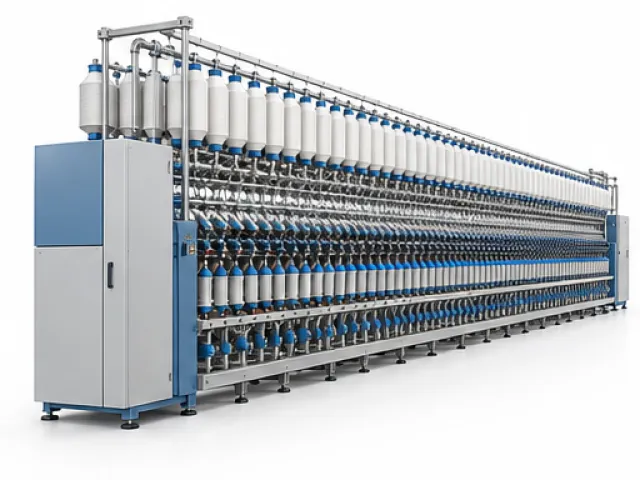
Equipment model · YQ800DS
The YQ800DS is a draw-texturing machine with four winding levels. It converts POY into low-elasticity polyester DTY using a stacked-disc friction false-twister, two biphenyl-vapour heaters and an 860 mm cooling rail, and an interlacing unit can be added. The base build carries 384 positions in 12 sections, handles 50–330 dtex and is rated at 650 m/min mechanical speed at the second roller. Standard packages are 5.0 kg double-conical, Ø250 × 250 mm. For a price, give the maker your POY, target DTY and section count.
Manufacturer: Yongle Textile Machinery
- Positions
- 384 / 12 sections / 32 per section
- Yarn range
- 50–330 dtex
- Maximum mechanical speed
- 650 m/min, second roller
- Heaters
- Biphenyl vapour; first 1,600 mm, second 980 mm
- Cooling rail
- 860 mm
- Standard package
- 5.0 kg, Ø250 × 250 mm double-conical
- Installed power
- 80.5 kW drives / 97.2 kW heating
- Size, 12 sections
- 24,100 × 7,780 × 3,100 mm
Published specifications
Values below come from the maintained catalogue record. The guide review date does not renew an earlier specification: read the dated source notes and confirm a current, matched configuration before comparing products.
Swipe the table sideways to see every column.
| Parameter | Published value |
|---|---|
| Spindle pitch | 100 mm |
| Base arrangement | 384 positions, 12 sections, 32 positions per section |
| Maximum mechanical speed | 650 m/min at second roller |
| Processing linear density | 50–330 dtex |
| Standard package mass | 5 kg |
What goes in and what comes out
Yongle's process text has the YQ800DS drawing and false-twisting POY into low-stretch polyester DTY. Interlacing is an add-on. If you want it, name it in the order together with its air supply and adjustment range; the base machine is a false-twist texturer, and air covering is a separate product family at the same company.
Nylon is mentioned in the company's general introduction, while the model text speaks only of polyester. A nylon buyer should ask for the heater settings and setup the factory would ship, then see them run on nylon POY.
Read the 50–330 dtex range against two numbers: the dtex of your incoming POY and the dtex of the finished yarn. Send both, with the feed lot and package, and list the properties your knitting or weaving customers check. [1]
YQ800DS figures by subsystem
The model page sets out the values below. Each row carries a question for the offer, because the build you are quoted can differ from the catalogue one. Two YQ800DS quotations may not match, and the advice to compare machine configurations line by line applies here. [1]
Swipe the table sideways to see every column.
| Subsystem | Published figure | Ask in the offer |
|---|---|---|
| Layout | 384 positions, 12 sections, 32 per section; the section count can change | The count you are ordering, plus layout and load data if it differs. |
| Pitch | 100 mm per position; 1,700 mm per section | How these fit the full installation drawing with access space. |
| Speed | 650 m/min maximum mechanical speed at the second roller | The running speed expected on your yarn and the kg/day output the maker will put in writing. |
| False twist | Stacked-disc friction unit | Disc arrangement for your yarn and the interval for replacing worn parts. |
| Heaters | Biphenyl vapour; first 1,600 mm, second 980 mm | Temperature range, heater manual and settings for your polymer. |
| Cooling | 860 mm rail | The full thread path from feed creel to take-up on the quoted machine. |
| Take-up | Ø90 mm friction roller; 5.0 kg standard package, Ø250 × 250 mm double-conical | Tube type, package density and how packages unwind at your customer. |
| Feed package | Ø435 × 120 mm, as the source writes it | A creel drawing that defines each dimension. |
| Body size, 12 sections | 24,100 × 7,780 × 3,100 mm, L × W × H | Extra floor space for loading, servicing and walkways. |
| Installed power | Drives 80.5 kW; heating 97.2 kW | The full electrical and utility list. |
Four take-up levels in one section
Yongle says stacking the winding in four levels lifts each section from 24 to 32 positions. The shafts on each level have their own drive, with feedback used to trim speed. More positions per metre only pay off if operators can thread, doff and adjust every level at your yarn and package size.
Ask to watch threading, loading and package removal on the top and bottom levels using your own feed and finished packages. Agree how operators reach each level, any lifting aids, and the setting and upkeep routine per level.
When packages come off, check build and unwinding from several positions on every level, and label where each sample came from. A fine package from one spot says little about the rest of the frame. [1]
Setting the running speed from a trial
Treat 650 m/min as the mechanical ceiling. The speed written into the contract should come from a trial run on your POY, with methods and pass limits agreed with the factory beforehand. [1]
Lock the inputs
Polymer, feed grade and lot, feed packages, position count, friction parts and interlacing yes or no.
Write down the recipe
Running speed, draw and twist settings, heater temperatures, take-up settings and interlacing conditions where fitted.
Test yarn and packages
Linear density, tensile and crimp values, appearance and dye uptake, and unwinding, from positions spread over all levels. Keep labelled samples.
Run for a set time
Count good kilograms, rejects, breaks, stops and operator calls, with settings held or every change logged.
Repeat on site
Carry the accepted yarn, settings and samples into commissioning, and settle any gap before signing an output guarantee.
Power ratings and running cost
Installed power is split into 80.5 kW for the mechanical drives and 97.2 kW for heating. Neither figure is a kWh per kilogram result, and neither covers interlacing air or the equipment around the machine.
The maker cites an energy saving of about 10%. If that matters to your payback, meter it yourself: decide what is metered, whether heat-up counts, how long the run lasts and which yarn counts as good, then compare against a machine making the same yarn at the same quality.
Request the electrical supply data, heater start-up and service steps, ambient and cooling needs, and air use for any options, all for the quoted build. [1]
What the quotation should list
The offer should name the version and section count, heater and cooling hardware, false-twist unit, tubes and package holders, controls with today's component brands, interlacing options and exclusions. Catalogue mentions of imported belts or branded bearings are general; ask for the actual bill of supply.
Add doffing instructions, service access, heater documentation, friction wear items, spares, training and who signs off acceptance. Price, lead time, warranty and support belong in the quotation itself. [1]
Prepare a useful enquiry
Check the information you have ready. Your selections stay on this device as a draft; nothing is sent to a manufacturer.
0 of 8 items ready
Open enquiry workspace →Checklist and notes are not uploaded or saved after reload. Copy or download a draft to keep it. Opening the workspace does not send this draft.
Sources & limitations
All figures come from the YQ800DS model page as saved on 7 October 2026; on 11 October the site showed a certificate error. Ask Yongle to confirm these in writing before you order: the current version and position count; the setup and running speed for your polymer; package, tube and creel drawings; the utility list; and the output and energy figures it will accept in the contract.
YQ800DS four-level winding draw-texturing machine
Shaoxing Yongle Textile Machinery · Undated; captured 7 October 2026. Current access failed 11 October 2026.
Yongle's YQ800DS page: the technical table, process description, four-level winding layout and installed power.
Each source above lists its publisher and the date it was checked. Editorial method · Report an outdated detail