
FHTDTK-A · Yarn winding
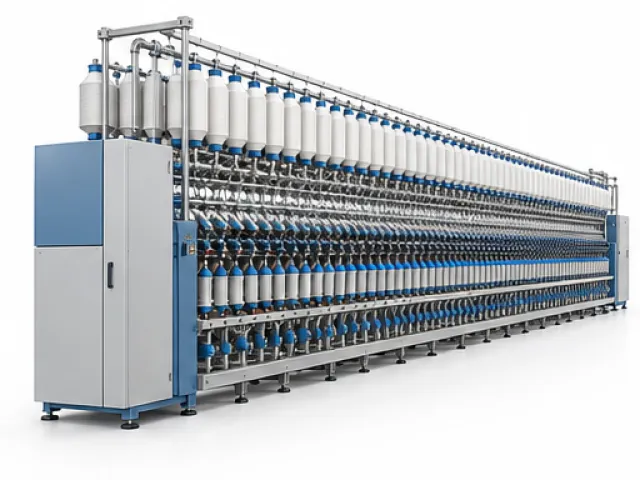
Equipment model · FHTDTK-A
The FHTDTK-A is a hank winder. It takes chemical-fibre yarn, thread or cord delivered in hanks and winds it onto a tube. Every position is controlled on its own, with automatic oiling, automatic tension control, overfeed, edge forming, anti-overlap, a break stop and a length stop. Feihu builds it in sections of four or six positions, drives the package with Ø80 × 220 friction rollers and allows packages up to 220 mm across. Speed is adjustable, but no figure is printed. A quote starts with your hank, your tube and the package the next machine has to unwind.
Manufacturer: Feihu Textile Machinery
- Job
- Hank-form yarn onto a tube or package
- Positions
- Four or six per section
- Package diameter
- Up to 220 mm
- Friction roller
- Ø80 × 220, straight or with a 3.5° taper
- Power
- 120 W per position; 380 V, 50 Hz, three-phase five-wire
- Section weight
- 205 kg
- Winding speed
- Adjustable; no figure published
Published specifications
Values below come from the maintained catalogue record. The guide review date does not renew an earlier specification: read the dated source notes and confirm a current, matched configuration before comparing products.
Swipe the table sideways to see every column.
| Parameter | Published value |
|---|---|
| Spindles per section | 4 or 6 |
| Maximum package diameter | 220 mm |
| Published power per spindle | 120 W |
| Standard supply | 380 V, 50 Hz, three-phase five-wire; export configuration to confirm |
Yarn in, package out
Feihu names three inputs for the FHTDTK-A: chemical-fibre yarn, thread and cord, all arriving as hanks. No count range is printed. Send the material, the count with its unit, the finish and a few real hanks, and ask whether they suit the machine.
On the output side the machine takes straight or tapered tubes, and a finished package can reach 220 mm in diameter. That figure limits size only, and no package weight is given. Send a tube drawing or sample, the package diameter and build you need, and how the yarn must come off in the next process.
The product photo shows hanks feeding the positions, with some tubes and wound packages beside the machine. Ask which of those tubes, holders and accessories are part of your order. [1]
Section, roller and power data
Each figure below comes from the FHTDTK-A table. Roller sizes describe the friction roller that drives the package, which is a different part from the tube. Section sizes cover one section before the machine head and working space are added.
One weight is printed for both section types. Before planning lifting and floor loads, ask for the weight of the configuration you order. [1]
Swipe the table sideways to see every column.
| Item | Feihu figure | Settle before ordering |
|---|---|---|
| Positions | 4 or 6 per section | The number of sections and the total positions. |
| Four-position section | 1,454 × 690 × 1,700 mm (L × W × H) | Applies to the four-position build only. |
| Six-position section | 2,150 × 690 × 1,700 mm (L × W × H) | Applies to the six-position build only. |
| Machine head | 360 mm long | Where the head sits on the drawing of your line. |
| Straight friction roller | Ø80 × 220 | The units, and which tube it pairs with. |
| Tapered friction roller | Ø80 at the large end × 220, 3.5° taper; special sizes to order | The roller and tube pair for your package, with any special size written into the contract. |
| Tubes and package | Straight or tapered tubes; package up to 220 mm in diameter | Tube dimensions and holders, plus a package weight limit. |
| Power | 380 V, 50 Hz, three-phase five-wire; 120 W per position; export version made to order | The supply in your plant and the load of the whole machine. |
| Weight | 205 kg per section | Which section the figure belongs to, and the weight of your build. |
Testing the named controls
The product page names the functions below but gives no range or tolerance for any of them. Ask Feihu to run each one with your hank and tube, following its own instructions, and note what you see. [1]
Swipe the table sideways to see every column.
| Function | What to watch | What to keep on file |
|---|---|---|
| Computer control per position | Which settings belong to each position, and how they come back after a stop | A setup record for each position. |
| Slow start, running speed and overfeed | How the hank pays off at start-up and at steady speed | The settings used and every time an operator stepped in. |
| Automatic tension control | How tension is set and checked on your yarn over a long run | The measuring method and its readings. |
| Automatic oiling | Which oil or finish suits your next process, and what the operator tops up or cleans | The oiling setting and how it will be judged. |
| Edge forming and anti-overlap | Whether full packages keep a clean edge and even build | Labelled packages from several positions and stages of the run. |
| Break stop and length stop | What the machine does at a break or at the set length, and what the operator does next | A note of each stop and the method for checking length. |
A trial that ends at the next machine
Feihu calls the machine fast and describes even tension and good package appearance, without figures. Set the expected output and package quality from a trial on your own yarn. [1]
Choose the lot and the target
Pick the hanks, tubes and target package, and name the downstream machine. Agree the samples and quality limits before the run.
Log every setting
Write down running speed, tension, overfeed and oiling, plus the section and roller arrangement. Mark any change made during the run.
Run long enough to count
Over an agreed time, count stops, breaks, operator interventions, rejects and good packages. Take packages from more than one position.
Unwind in production
Put the packages on the weaving, knitting or other machine that will use them. Note unwinding faults and fabric defects against each setup.
Take the result to installation
Use the approved setup sheet and sample packages at commissioning, and agree in advance what happens if the delivered machine falls short.
What the quotation should cover
Ask Feihu for one drawing of the machine as offered: the sections, the head, where hanks are loaded, where full packages come off, and the space operators and fitters need. The section table alone gives neither the floor plan nor the total lifting weight.
The offer should list the tube holders, rollers, control version, oiling and tension units, tools and accessories, any special tube, and the electrical build for your country. Ask for current instructions on threading, adjustment, cleaning, lubrication and replacing wear parts.
Settle training, installation, spare parts, warranty and delivery in the contract. Price, real output, power drawn under load and lead time come from the quotation and the trial. [1]
Prepare a useful enquiry
Check the information you have ready. Your selections stay on this device as a draft; nothing is sent to a manufacturer.
0 of 8 items ready
Open enquiry workspace →Checklist and notes are not uploaded or saved after reload. Copy or download a draft to keep it. Opening the workspace does not send this draft.
Sources & limitations
The FHTDTK-A page gives section, roller and electrical data and a list of controls, but no winding speed, yarn-count range, package weight limit or production result. Your purchase contract should carry Feihu's written answer on each of these: the speed and package quality on your yarn, the count range it accepts, the maximum package weight, the weight of your configuration, the total electrical load, and everything included in the supply.
FHTDTK-A individually controlled numerical-control winding machine
Zhuji Feihu Textile Machinery · Undated; accessed 11 October 2026
The machine's job, its list of controls, and the table of sections, friction rollers, tubes, power and weight. No speed figure is given.
Each source above lists its publisher and the date it was checked. Editorial method · Report an outdated detail