
B-type opening and squeezing series
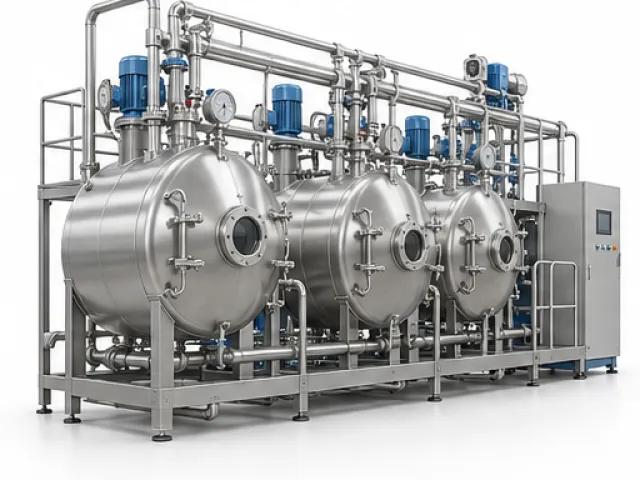
Equipment series · B-type opening and squeezing series
The B-type from Shaoxing Kanglide Machinery is a continuous line that opens, slits, washes lint out of and squeezes cotton knitted fabric, taking it in open-width or tubular. Kanglide's parameter table gives 0–95 m/min, a 2,200–2,500 mm working width, 38 kW design power and an overall envelope of 9,900 × 4,500 × 6,000 mm. For a quote, send the knit construction and width, say how the fabric arrives and whether it needs cutting, and state the water content your next process expects.
Manufacturer: Shaoxing Kanglide Machinery Co., Ltd.
- Fabric
- Open-width or tubular cotton knitted fabric
- Stages
- Opening, slitting, lint removal and squeezing
- Speed / working width
- 0–95 m/min / 2,200–2,500 mm
- Design power / supply
- 38 kW / AC 380 V, 50 Hz, three phase
- Overall L × W × H
- 9,900 × 4,500 × 6,000 mm
- Connections
- Air 0.4 MPa, Ø8; water in 0.1 MPa, DN40; outlet DN65
Published specifications
Values below come from the maintained catalogue record. The guide review date does not renew an earlier specification: read the dated source notes and confirm a current, matched configuration before comparing products.
Swipe the table sideways to see every column.
| Parameter | Published value |
|---|---|
| Fabric application | Cotton knitted fabric |
| Incoming fabric forms | Open-width or tubular |
| Functions | Opening, slitting, lint removal and squeezing |
What happens along the line
- Small padder and high untwisting unit feed the line
- Cutter on the main machine for tubular knits
- Automatic filtration on a four-tank, eight-spray wash
Cloth comes in through a small padder and climbs to a high untwisting unit. On the main machine a cutting device slits the tube where the job calls for it. A lint-washing section follows, made up of four tanks, four filters and eight spray groups, with filtration drawn as automatic. A padder then presses out water and an exit device hands the fabric on.
Kanglide's feature sheet adds adjustable spreading rollers and filtration control. Covers over parts of the wash and a stainless outer skin are marked as options, so name the ones you want and make sure they reach the quoted inclusion list.
Tell Kanglide whether your knit arrives flat or as a tube and whether it must be cut. Ask which cutting and edge-detection parts the offer contains, how the cloth is opened and supported on its way through, and which settings would change for your fabric. [1] [2] [3]
B-type design figures
These values sit under the B-type heading on Kanglide's page, before the A-type and the softening line. They describe the design; the right-hand column lists what to get confirmed for your own plant. [1] [2]
Swipe the table sideways to see every column.
| Item | B-type figure | Get confirmed for your plant |
|---|---|---|
| Speed | 0–95 m/min | The running speed on your fabric and the output accepted in the trial. |
| Working width | 2,200–2,500 mm | The width you order and the range of fabric widths it will run. |
| Electrical supply | AC 380 V, 50 Hz, three phase | Installed load, protection and any extra equipment on the same feed. |
| Design power | 38 kW | A full load schedule. Meter energy in the trial if you are comparing running costs; this is not kWh per tonne. |
| Compressed air | 0.4 MPa, Ø8 connection | Air consumption, air quality and the fitting supplied. |
| Water in / out | 0.1 MPa inlet, DN40; DN65 outlet | Flow, water quality, discharge limits and who lays the pipes. A pipe size gives no consumption. |
| Overall L × W × H | 9,900 × 4,500 × 6,000 mm | A dimensioned layout with roof clearance, foundations, handling, service access and trolley space. |
The softening line is a different machine
Below the B-type, Kanglide's page shows an A-type and then a line for opening, slitting, lint removal, softening and squeezing. That last drawing inserts a softener stage and one more padder, and its table reads 45 kW and 13,200 × 4,500 × 6,000 mm.
Order the softening version by name if softener must go on at this step, and ask for its own drawing, treatment scope, chemical handling and utility data. Agree in advance how the softened fabric will be judged.
Set the B-type beside any other opener or dewatering machine by matching stages and fabric scope before you look at speed or width, and compare configurations line by line. A short opener with no wash section does another job even when its labels look close. In knit finishing, this kind of line usually comes ahead of the stenter, so ask what moisture and width that machine needs from it. [1]
Prove the result on your own knit
Acceptance steps for the B-type
Bring cotton knit in the form and wet state it will really arrive in. Kanglide's table publishes no lint, moisture or fabric-quality figure, so decide what your next process needs and how each result will be measured. A trial on your own material answers these questions before any money is paid.
Log the incoming knit
Construction, width, flat or tubular form, wet state, seams and other variation, and whether a cut is needed. Keep a reference piece signed by both sides.
Inspect opening and slitting
Watch the arrangement Kanglide proposes and check fabric form, cut edge, creasing and distortion against agreed limits. Note each adjustment the technician makes.
Judge washing and filtration
Settle a repeatable way to rate leftover lint and fabric appearance. Note wash and filter settings, filter cleaning and what the filters collect. The number of tanks gives no removal percentage.
Weigh the squeezed fabric
Agree sampling positions and the method for water content. Write speed, padder settings and incoming condition beside every reading.
Run it long enough
Over an agreed run, record accepted output, pauses, operator tasks and utilities. Check exit handling and the transfer onward, keep samples and settings, and clear deviations before signing off commissioning.
What the offer and handover should cover
Ask for a stage list naming the ordered width, cutting and control parts, filtration equipment, covers or cladding, padder and exit handling. Have Kanglide list any separate tanks, services or connecting equipment you must supply, along with an electrical schedule, and plan the hall from a current layout drawing.
Put in writing who installs, connects utilities, commissions and trains your operators. Request operating and maintenance manuals, a filter-cleaning procedure and a list of wear parts and spares for the exact build. The feature sheet's talk of easy upkeep is no substitute for a maintenance plan.
Price, lead time and warranty go in the written offer next to the fabric acceptance procedure. Any output or energy promise should name the fabric and running conditions it covers. [1] [3]
Prepare a useful enquiry
Check the information you have ready. Your selections stay on this device as a draft; nothing is sent to a manufacturer.
0 of 8 items ready
Open enquiry workspace →Checklist and notes are not uploaded or saved after reload. Copy or download a draft to keep it. Opening the workspace does not send this draft.
Sources & limitations
Figures and stage descriptions here come from Kanglide's B-type page, its parameter image and its feature sheet. Before ordering, have Kanglide confirm in writing the stage list and options for your width, the power and utility demand of that build, the lint and water-content targets measured on your fabric under trial conditions, and the price, lead time, warranty and spare-part terms.
B-type opening/slitting/lint-removal/squeezing page
Shaoxing Kanglide Machinery · Undated; accessed 11 October 2026
Which fabric the B-type handles and which stages it combines. The A-type and the softening line appear separately lower down the page.
B-type layout and design-parameter images
Shaoxing Kanglide Machinery · Undated; accessed 11 October 2026
The wash layout of four tanks and filters, speed and width, 38 kW, air and water connections, and the 9,900 × 4,500 × 6,000 mm envelope.
B-type technical-feature image
Shaoxing Kanglide Machinery · Undated; accessed 11 October 2026
Spreading rollers, cutting, filtration and padder details, with the optional items marked.
Each source above lists its publisher and the date it was checked. Editorial method · Report an outdated detail