
Hot-air stenter family
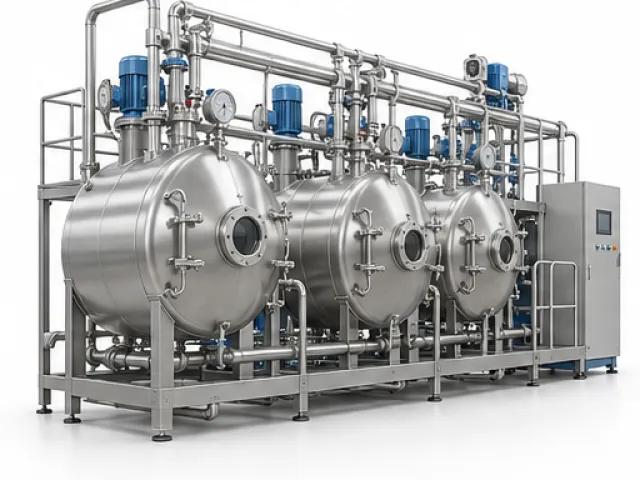
Equipment series · Hot-air stenter family
The Yonglitong hot-air stenter is a drying and heat-setting line built to order for knitted, pile and woven fabric. Its entry section adjusts overfeed from −30% to +80% between the upper overfeed roller and the pin chain, with the two sides set independently, and adds compressed-air edge opening, edge stripping and E+L edge detection for knits. The oven circulates air through removable internal ducts and is drawn with gas or with thermal-oil and medium-pressure-steam heating. The burner page quotes a 40:1 adjustment ratio. Width, speed, chamber count and temperatures are fixed in the offer for your fabric.
Manufacturer: Yonglitong Dyeing Machinery
- Maker
- Yonglitong Dyeing Machinery, Xinchang
- Fabric groups
- Knitted, pile and woven
- Entry overfeed
- −30% to +80%, left and right set independently
- Edge handling for knits
- Compressed-air edge opening, edge stripping, E+L edge detection
- Heating shown
- Gas, or thermal oil and medium-pressure steam
- Burner
- 40:1 adjustment ratio; optional burner offered
- Example model
- YLT158, from a trade report dated 16 October 2024
Published specifications
Values below come from the maintained catalogue record. The guide review date does not renew an earlier specification: read the dated source notes and confirm a current, matched configuration before comparing products.
Swipe the table sideways to see every column.
| Parameter | Published value |
|---|---|
| Heating process | Hot-air circulation |
| Fabric categories | Knitted, pile and woven fabrics |
| Included functional sections described | Cooling, overfeed, width adjustment and moisture extraction |
What goes into a Yonglitong stenter line
A stenter usually closes a dyeing and finishing route, taking wet cloth and sending it on dry, set and at width. Yonglitong's process description lists the modules a line can hold: entry and exit devices, padding, hot-air circulation, cooling, weft straightening, chambers, overfeed, width adjustment and moisture extraction. Your quotation should say which of these you are buying and show them together on one layout drawing. [1]
Infeed and wet stage
State how the cloth arrives, in rope, open width or on a batch, and whether a padder or other wet step comes before the frame. Give the moisture it carries in.
Edges, pinning and transport
Name the edge opening, stripping and detection parts, the pin or clip transport, the straightener, the overfeed range and how width is set, all for your actual cloth.
Heated chambers
Choose the heat source, number of chambers, nozzle and circulation layout, the running recipe and where the extraction scope ends.
Cooling and delivery
Describe how the cloth is cooled and handed to the next stage, which appearance or handle limits apply and what room operators need around the exit.
Overfeed and edge parts at the entry
- Overfeed window of −30% to +80%, adjustable per side.
The entry sheet allows overfeed anywhere from −30% to +80% as cloth moves from the upper overfeed roller onto the pin chain. The left and right overfeed rates have their own settings. For knitted goods, jets of compressed air uncurl the edges, an edge stripper follows, and an E+L system tracks the selvedge.
Have the quoted machine's overfeed range and mechanism written into the offer, together with the reference speeds the percentage is calculated from and the way an operator adjusts it. The range tells you what the hardware allows. The shrinkage your cloth ends up with depends on the fabric and the recipe you run.
Feed your own cloth through entry and pinning and watch the edges at the settings you plan to use in production. Ask for the compressed-air demand, the controls, the sensor make and the tasks left to the operator. The sheet says detection works on all materials and colours, so test it on your darkest and most awkward shades. [2]
Oven air path, heating choice and burner
Inside the oven, hot air travels through internal ducts that lift out, a circulation box and a set of nozzles. The oven sheet draws two heating layouts, one gas-fired and one using thermal oil or medium-pressure steam. They are alternatives, so pick the one your mill can supply.
Once the heat source is chosen, ask for its thermal duty and the fuel, steam or oil conditions it needs, the number and length of chambers, the temperature schedule, the circulation and extraction layout and how staff reach the ducts to clean them. The drawings carry no airflow, evaporation or heat-capacity figures, so those have to come in the offer.
A separate burner page gives a 40:1 adjustment ratio and mentions an optional burner. That ratio measures how far the flame turns down, and it says nothing about the energy use of the whole frame. The electrical-power line on that page is garbled. Ask for the current burner datasheet and a full machine load and utility schedule. [3] [4]
Where the YLT158 fits
The YLT158 is the one model name tied to this range, through a China Textile News exhibition report from 16 October 2024. In it, the company manager says knit handling was added to a frame meant for woven goods: reduced tension, extra overfeed and a mechanical weft straightener.
The report describes modular PLC control and two geared drive motors run by inverters or by servo control. When you order a YLT158, write the revision and the chosen drive into the contract. For any other machine in the range, ask whether either drive is offered at all.
Working width, running speed, chamber count and energy per unit of output are absent from the report. Agree them in the offer and check them in your fabric trial. [5]
Figures to get in the offer
Yonglitong publishes subsystem detail but no complete datasheet for the range. Ask for each figure below tied to the exact model, fabric route and options, which also lets you set offers from different makers side by side. [1] [2] [3] [4]
Swipe the table sideways to see every column.
| Item | What the offer should state | Why you need it |
|---|---|---|
| Working range | Usable width, speed range and the fabric and recipe they apply to | A top line speed says little about how much cloth passes your quality check |
| Heat | Heat source, chambers, temperatures, utility demand and extraction scope | The sheets show several heat sources, and each one changes the rating |
| Cloth control | Entry tension and overfeed, edge parts, straightening, transport and width setting | Your fabric and the modules supplied decide how the trial is set up |
| Installation | Full layout, loads, utilities, access, duct and stack connection and delivery end | A photograph or a single chamber drawing cannot be built from |
| Controls and options | PLC and drive version, sensor and parts list and optional modules | The YLT158 report and the system sheets each describe different parts of the range |
| Acceptance | Fabric lot, test methods, run length, accepted output and energy boundary | Pass marks agreed before delivery avoid arguments at handover |
A fabric trial with the settings on record
Set pass marks for your fabric and its end use before the run, then repeat the same run when the frame is installed. [1] [2] [3] [5]
Describe the incoming lot
Write down blend, construction, width, weight per square metre, moisture on entry and how the cloth was prepared.
Freeze the recipe
Note padding if used, speed, overfeed, width and transport settings, chamber temperatures, airflow, extraction, cooling and delivery.
Judge the finished cloth
Condition the samples, then check width, dimensional stability, straightness, appearance and handle at agreed points along and across the piece. Keep labelled pieces for later.
Count good output and utilities
Log accepted metres, rejects, stops and run time. For an energy comparison, fix the meters, the system boundary, the warm-up period and the output figure energy is divided by.
Repeat at handover
Run the same acceptance test on site with the approved fabric, recipe and samples, and name who corrects any shortfall and who provides training, maintenance and spare-parts support.
Prepare a useful enquiry
Check the information you have ready. Your selections stay on this device as a draft; nothing is sent to a manufacturer.
0 of 8 items ready
Open enquiry workspace →Checklist and notes are not uploaded or saved after reload. Copy or download a draft to keep it. Opening the workspace does not send this draft.
Sources & limitations
Get written confirmation from Yonglitong on the following points ahead of the order: the model, revision and modules quoted; usable width, speed range, chamber count and temperature schedule; the overfeed range and edge parts fitted to your frame; the heat source, thermal duty and a burner datasheet with a correct power figure; the PLC and drive version; and the accepted output and energy use measured in the agreed trial.
Company introduction and hot-air stenter process description
Zhejiang Yonglitong Dyeing Machinery · Undated; accessed 11 October 2026
Names the line modules, from entry, padding and circulation to cooling, straightening and moisture extraction, and the three fabric routes.
Overfeeding, edge-stripping and edge-detecting system sheet
Zhejiang Yonglitong Dyeing Machinery · Undated; accessed and original image reviewed 11 October 2026
Entry sheet with the overfeed window, per-side adjustment, air-jet edge opening, edge stripper and E+L detection.
Internal air-duct oven system sheet
Zhejiang Yonglitong Dyeing Machinery · Undated; accessed and original image reviewed 11 October 2026
Oven drawing with lift-out ducts, circulation box, nozzle set and the alternative heating layouts.
Burner description and option note
Zhejiang Yonglitong Dyeing Machinery · Undated; accessed 11 October 2026
Burner page with the turndown ratio and optional burner. Request a clean datasheet for the power figure.
Yonglitong: further performance development of a new hot-air stenter
China Textile News; report by Wang Jizheng · 16 October 2024; reviewed 11 October 2026
Exhibition article on the YLT158 covering its knit handling, modular PLC and inverter or servo drive.
Each source above lists its publisher and the date it was checked. Editorial method · Report an outdated detail