
LH2000
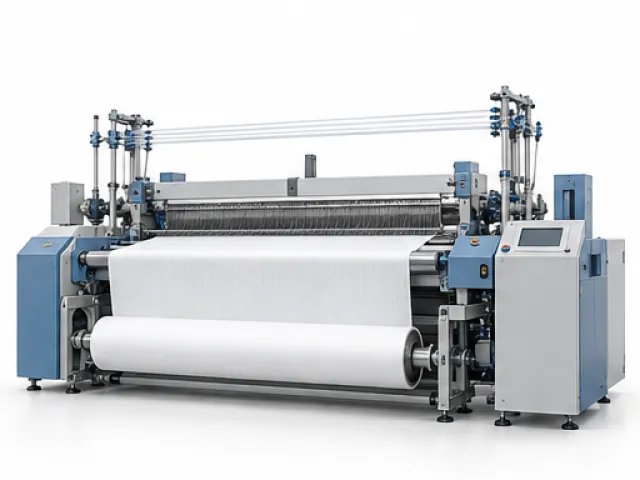
Equipment series · LH2000
The LH2000 is a water-jet loom series that Zhejiang Qifang sells under its Lanhua brand for weaving nylon and polyester filament. Qifang names taffeta, umbrella cloth, bag fabric, Oxford cloth and decorative fabric as typical work. Effective reed widths are 1,500, 1,700, 1,900, 2,100 or 2,300 mm. Shedding is plain on 4, 6 or 8 heald frames or by dobby with up to 16, and weft insertion uses a single or double jet. A motor drives the loom directly and stops it with an electromagnetic brake, though the printed motor rating is garbled. For a quote, send your filament specification, weave, density and the cloth width you need, and ask for the corrected motor figure.
Manufacturer: Zhejiang Qifang Machinery Co., Ltd.
- Maker
- Zhejiang Qifang Machinery, Lanhua brand
- Fabrics named
- Nylon and polyester filament: taffeta, umbrella, bag, Oxford, decorative
- Effective reed widths
- 1,500 / 1,700 / 1,900 / 2,100 / 2,300 mm
- Shedding
- Plain on 4, 6 or 8 heald frames; dobby up to 16
- Weft insertion
- Single or double jet; 1×1, 2×2 or free-exchange selection
- Drive and frame
- Direct motor drive, electromagnetic brake, oil-bath box frame
Published specifications
Values below come from the maintained catalogue record. The guide review date does not renew an earlier specification: read the dated source notes and confirm a current, matched configuration before comparing products.
Swipe the table sideways to see every column.
| Parameter | Published value |
|---|---|
| Working width choices | 1500 / 1700 / 1900 / 2100 / 2300 mm |
| Weft insertion | Water jet; single or double jet variants |
| Maximum dobby shafts | 16 |
| Listed yarn materials | Nylon and polyester |
Fabrics and reed width
Qifang aims the LH2000 at filament weaving in nylon and polyester. Its application list covers taffeta, umbrella cloth, bag fabric, Oxford cloth and decorative fabric. If your cloth sits in that list, send the actual yarn specification, weave, ends and picks, and the finishing route it will go through, so Qifang can say whether the loom suits your construction.
Choose the reed width from the cloth backwards, starting with the finished width you sell and the point in the process where it is measured. Order one of the five published widths as a fixed option, then ask how far that loom can weave narrower than its reed and how the selvedges are formed at your width.
For another fibre or a much heavier structure, ask Qifang for a sample run or a different machine. The company also builds air-jet and rapier looms, and the right weaving route for your fabric may lie with one of those. [1] [2]
Choosing the loom setup
The Chinese and English pages describe one series, with some rough translation between them. Work from a configuration sheet that names every option in the table below, and hold each quote against that sheet. [1] [2]
Swipe the table sideways to see every column.
| Item | Catalogue entry | What to settle in the offer |
|---|---|---|
| Shedding | Plain with 4, 6 or 8 frames; dobby with up to 16 | The frame count your weave needs and the shedding unit and controls supplied. Jacquard heads are bought separately. |
| Weft selection | Single or double jet; 1×1, 2×2 and free exchange | How many wefts you insert, in what order, and the exact selection package fitted. |
| Measuring and storage | RS and electronic length-measuring and weft-storage units | Which unit is fitted, how it is adjusted and whether it handles your filament. |
| Detection and cutting | Electrical or photoelectric weft detection, yarn-break stops, mechanical scissors | The detectors, stop functions and cutting and selvedge setup, tried on your own yarn. |
| Drive and frame | Direct motor drive, electromagnetic brake, box frame with oil-bath lubrication | An up-to-date drive and control list and the maintenance instructions. |
| Motor rating | Printed as 1.5kw\2.2kw.208kw in both languages | A corrected motor schedule and nameplate data. Leave the last figure out of any power sizing. |
Water suction and mill services
The table heading translates as drying of cloth. Under it, Qifang lists suction pipes, a fan and a separator that splits air from water, all drawing moisture out of the fabric on the loom. Ask how wet the cloth is when it leaves and whether you will need a dryer downstream.
The page gives no figures for water quality, inlet flow or pressure, drainage, or treatment and reuse. Ask Qifang for each of them at your width and options. Request the full electrical load as well, covering the suction fan and the other auxiliaries, once the motor figure has been corrected.
Qifang calls the loom efficient and cheap to run without naming a fabric or a test behind the claim. Judge it on accepted metres and metered water and power over an agreed run. Write rejects, stops and suction settings down next to the speed, so a quick run that turned out poor or wet fabric never becomes the benchmark. [1] [2]
A trial you can repeat after delivery
Settle the trial method with Qifang before anyone starts the loom. A trial with your own filament on the exact configuration you are buying gives the contract something firm to refer to. [1] [2]
Lock the fabric brief
Write down filament type and specification, weave, width, density, how the yarn is prepared and what happens to the cloth next. Keep a reference sample.
List the loom as tested
Note reed width, frames or dobby, jet and selection package, storage and detection devices, selvedge treatment and suction parts.
Inspect the cloth
Set measurable limits for width, construction and visible faults. Take samples from across the run and record how they were picked and graded.
Run long enough to count
Log duration, good and rejected fabric, stops, operator interventions and settings. Meter water and electricity on the same run when running cost is part of the decision.
Carry it to your mill
Keep the settings and approved samples. Agree the commissioning checks, who adjusts what, and the paperwork the delivered loom needs to repeat the result.
What the quotation should contain
Qifang says key components on the LH2000 are imported, without naming a brand for each part. Ask for a component list for your loom with makes and models, along with any substitutions Qifang reserves the right to make.
Request a layout showing access and maintenance space, the corrected drive data, utility and drainage needs, the auxiliaries in the supply and the commissioning scope. Add training, manuals, lubrication and maintenance instructions and a list of wear parts to the handover.
Price, delivery date, warranty and a proven speed are missing from the catalogue page. Ask for them in the quotation, with the agreed trial record and configuration sheet attached. Price optional accessories and any drying or finishing machines on separate lines, and say who supplies each one. [1] [2]
Prepare a useful enquiry
Check the information you have ready. Your selections stay on this device as a draft; nothing is sent to a manufacturer.
0 of 8 items ready
Open enquiry workspace →Checklist and notes are not uploaded or saved after reload. Copy or download a draft to keep it. Opening the workspace does not send this draft.
Sources & limitations
All figures here come from Qifang's Chinese and English LH2000 pages, and nobody from the site has woven on this loom. Get Qifang to state these points in writing ahead of any order: the complete configuration you are buying, the corrected motor rating and total electrical load, water and drainage requirements, the component makes fitted, the cloth standard reached in your trial, and the price, delivery date and warranty.
LH2000 series water-jet loom, Chinese catalogue page
Zhejiang Qifang Machinery / Lanhua · Undated; accessed 11 October 2026
Applications, reed widths, shedding and jet options, drive and detection details, and the water-removal parts. The motor line is printed in a garbled form.
LH2000 series water-jet loom, English catalogue page
Zhejiang Qifang Machinery / Lanhua · Undated; accessed 11 October 2026
The same table in English. It carries no speed, water flow or commercial terms, and its motor line is just as hard to read.
Each source above lists its publisher and the date it was checked. Editorial method · Report an outdated detail